A recently released documentary reveals that R.C. Christian, a pseudonym for the man who provided the designs and funding for the controversial Georgia Guidestones monument, was Herbert Hinie Kersten, a doctor from Fort Dodge, Iowa. Kersten appears to have expressed support for David Duke, former Grand Wizard of the Knights of the Ku Klux Klan, in a letter written to the South Florida Sun Sentinel. William Sayles Doan, an author and Fort Dodge historian, claims on camera that Kersten was an outspoken racist who voiced plans to create a measurement to definitively prove that whites – and in particular Northern Europeans – were the world’s superior race.
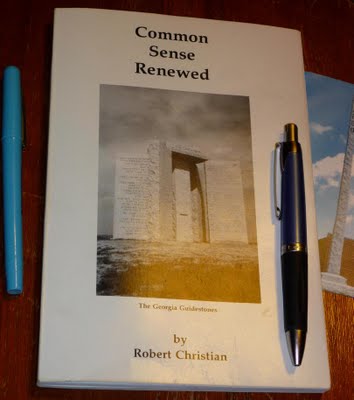
Kersten was aided by his friend, Robert Merryman, publisher of the Ft. Dodge Messenger. Merryman is known to have arranged the publication of Common Sense Renewed, a book intended to explain the purpose of the Georgia Guidestones.
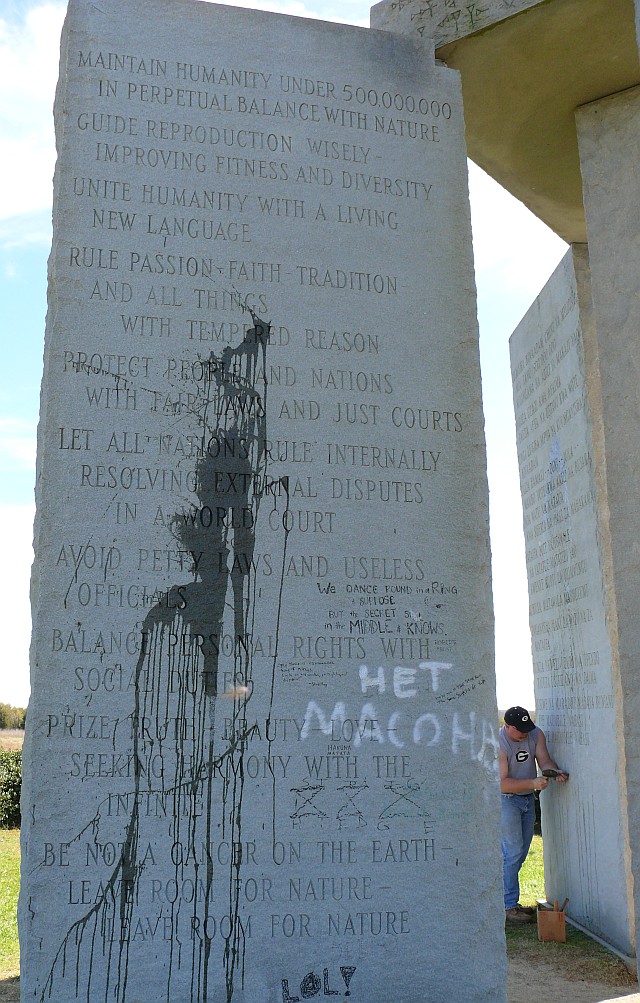
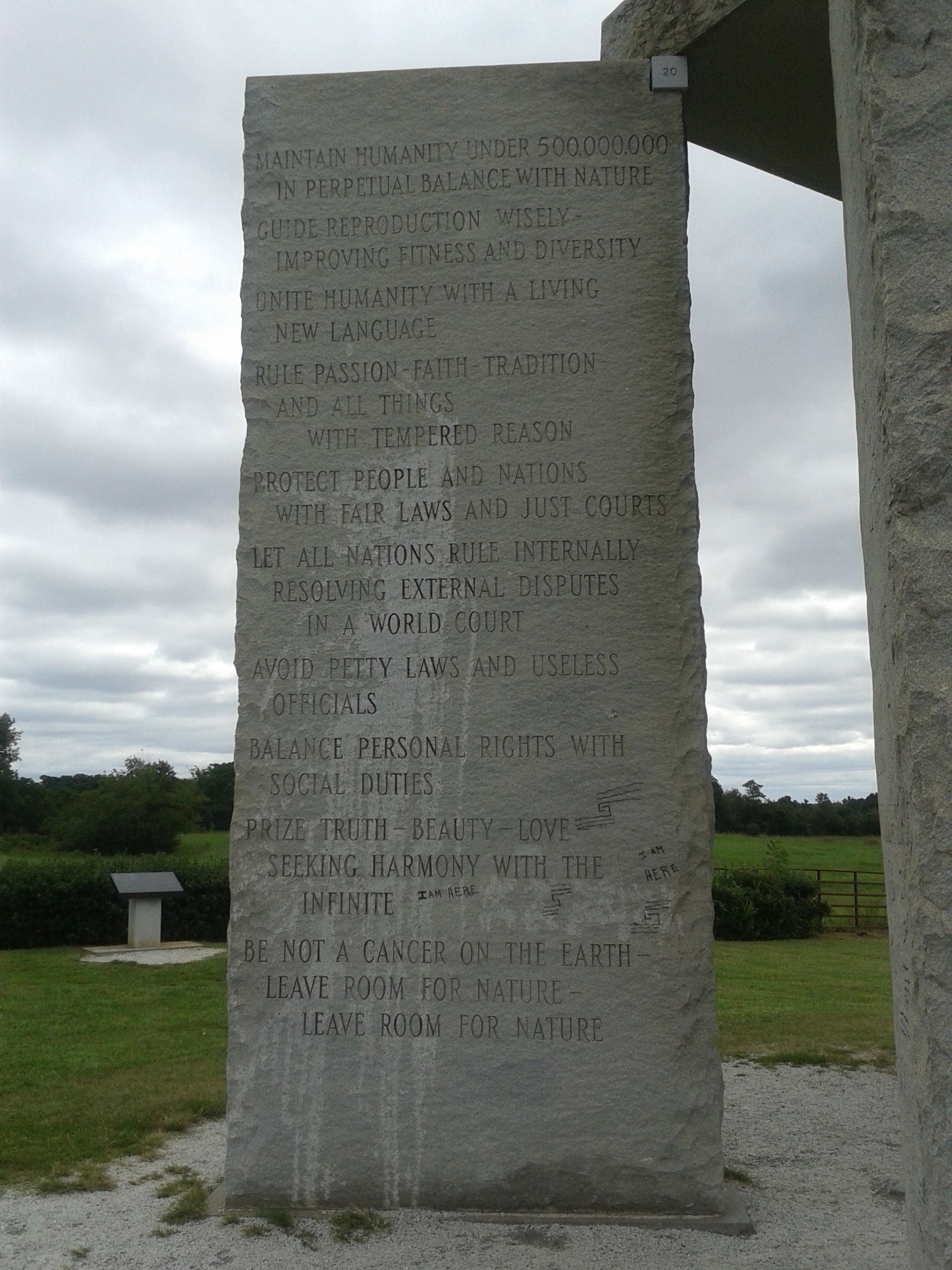
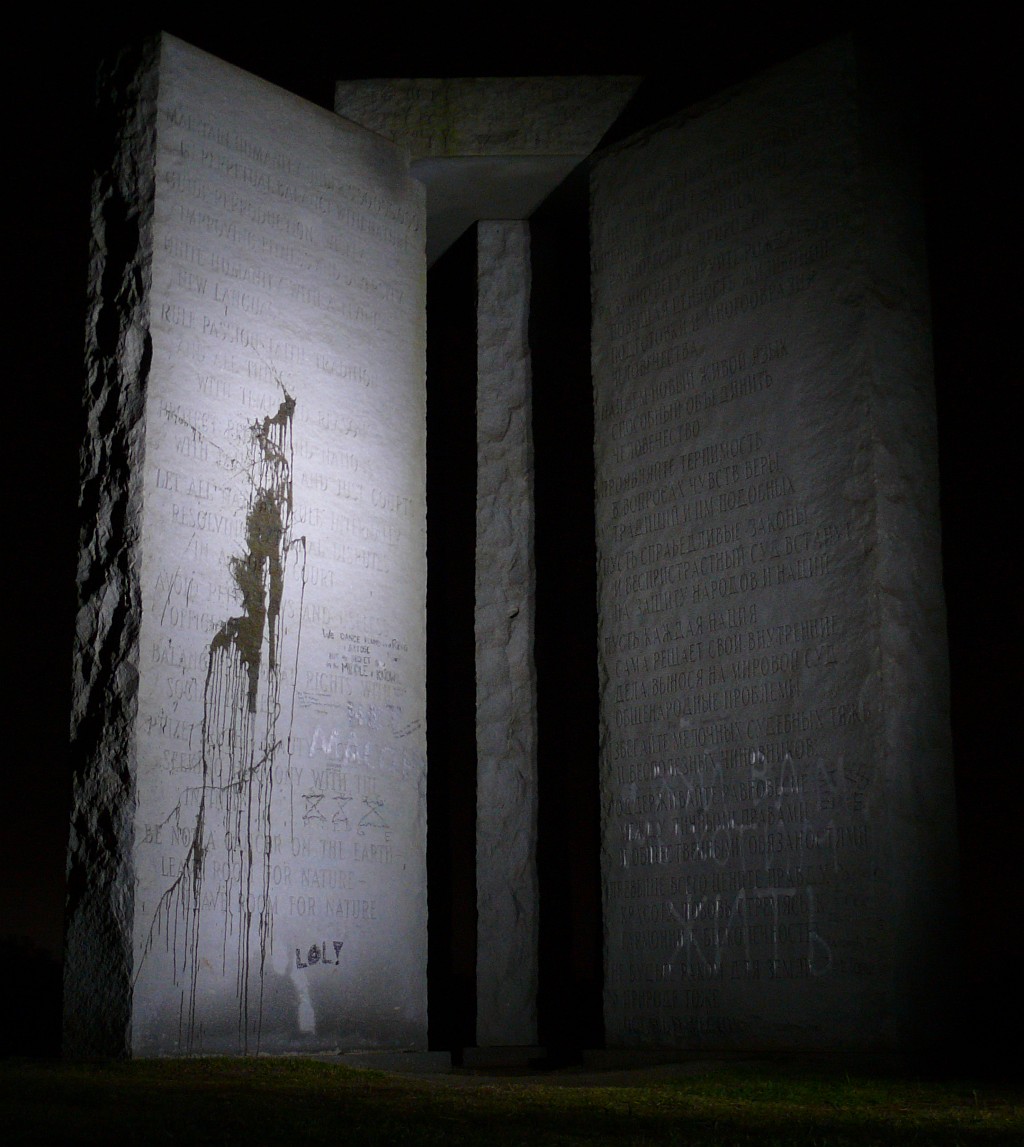
The Georgia Guidestones is a highly controversial granite structure modeled loosely after Stonehenge, erected in northeast Georgia and shrouded in mystery. The monument proclaims ten commandments in eight different languages, the most contentious being the establishment of a global population of only 500-million, a reduction of over 6.5-billion people from current levels. Other commandments include the development of a global language and a worldwide government. While most of the commandments are written vaguely and appear benign, Common Sense Renewed details a totalitarian global government where every aspect of human life — including birth, death, marriage, childbearing, work, property ownership, travel, health care, education and the right to vote — are regulated by the state.
The extensive eugenic measures outlined in Common Sense Renewed may reflect the involvement of William Shockley, the Nobel Prize-winning physicist who co-invented the transistor. Shockley also became known for his claims that blacks are genetically inferior to whites. He espoused financial rewards to encourage voluntary sterilization for people having sub-100 IQs.
According to Doan, Kersten was proud of his friendship with Shockley.
Eugenics is the management of human breeding with the intent to produce people carrying desired characteristics like intelligence, beauty, athleticism or even docility. Eugenics advocates usually also intend to eliminate “bad genes” from populations by discouraging childbearing among people with undesirable attributes; however, population culling is another tactic wielded by eugenicists to get rid of unwanted people.
Often, undesirable genetic concepts extend to encompass entire races. Eugenics is best known as the Nazi pursuit of the purified Aryan Race involving German programs to eliminate the mentally ill, Jews, gypsies, homosexuals and even political opposition. However, eugenics initiatives originated in the USA that influenced Hitler’s Germany. After the conclusion of World War II, unfavorable Nazi eugenics publicity derailed other eugenics movements for years to come.
My involvement with the documentary
In early 2010, I was involved with the development of the documentary, Dark Clouds over Elberton, a Chris Pinto production made with the assistance of Mike Bennett, the podcaster behind the “End Times” focused FutureQuake program. In addition to being filmed in numerous scenes, I also provided Pinto with my research and I arranged his interview with Wyatt C. Martin, the key figure in uncovering the identity of R.C. Christian. However, within a few days I withdrew from the project after witnessing unethical and disrespectful behavior from both Pinto and Bennett. Most importantly, Pinto and Bennett boastfully exploited Wyatt Martin’s trust – and ridiculed the man in the process — in order to covertly obtain R.C. Christian’s address in Ft. Dodge, Iowa.
Wyatt C. Martin has maintained his vow to protect the identity of R.C. Christian since 1979. I deeply respect Martin and I consider him a man of rare character and morality.
Martin had suffered a debilitating stroke only a few weeks before I arranged the Pinto/Bennett interview and Martin originally declined the interview until I vouched for the character of the pair. Consequently, I felt responsible for their betrayal on Wyatt Martin.
I wrote a personal account of these incidents in March, 2010, almost immediately after I withdrew from the project. Again, it is a personal account and I never intended to publish it, but with the release of Dark Clouds Over Elberton, I feel it is necessary to include portions of it in a second article in order to preserve Wyatt C. Martin’s character and legacy.
A Rosicrucian Connection
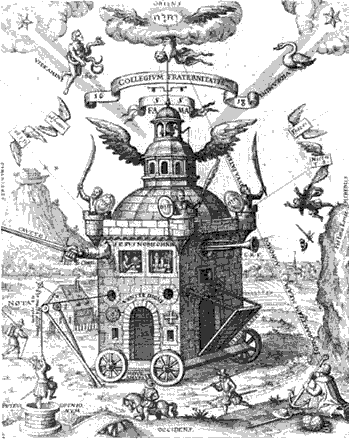
While the involvement of the Freemasons in building of the Georgia Guidestones is well established, the shadowy secret organization known as the Rosicrucians have long been suspected to be the hidden hand behind the monument, primarily due to the Kersten’s choice of R.C. Christian as his pseudonym.
The Rosicrusians are not just one the most secretive of all secret organizations, but some claim that they are the “Hidden Hand” that has been guiding world events for centuries. Furthermore, the Rosicrucians claim to have mastered many occult, supernatural practices involving things like out-of-body projection, mind control and even immortality. The secret order was purportedly founded in the 15th Century by Christian Rosenkreuz who some claim later manifested as the Count of St. Germain in the 18th Century. Rosicrucians have been associated with vampires and the Batman villain, Ra’s al Ghul, was clearly inspired by Rosicrucian lore.
The Rosicrucians also appear to have influenced the establishment of speculative Freemasonry.
The documentary briefly shows a Rosicrucian document uncovered in Coggins Industries that might describe a time capsule purportedly buried at the Georgia Guidestones site. The following incomplete transcription was made from that footage:
[Editor’s note the entire document was in upper case]
To whomever comes across this presenting:
Contained herein are keys that have been awaited to be placed here in proper sequencing and in proper order to announce the return and the activation of those events of prophecy that that signal these events. Those who have guarded this great mystery and who have guarded the evolution of the human species itself are returning. It has begun.
This monument known as the Georgia Guide Stones (sic) shall find threads unto the revelation of the mystery in the name R.C. Christian otherwise known unto that contingency that is responsible for the erection of this monument as Christian Rosenkretz (1378-1484).
This presentation of keys upon the finding of it is to be delivered to the Elberton Star. The Elberton Star is to deliver it to the Atlanta Rosicrucian Society. The Rosicrucian contact number is 1. That number is derived from the synchronistic mystery of 404-2994-4172 in Atlanta.
It is only those with the understand (sic) of the rose and its return who will be capable of deciphering the codes and the keys that are contained herein:
Unto this great mystery shall it in due time be unveiled likened unto… Great portal reads only, “Know thyself.” Come indeed the bridegroom bearing the knowledge of the perfect… to bring forth the gold and this the purity of the rose.. This monument has now been activated
You are greatly loved mankind. Once we saw through the glass … shall see face to face. Do not fear. We are with you through the
A YouTube video posted yesterday, November 8, persuasively explains the origin of a granite cube recently added to the Georgia Guidestones. The cube was placed inside a five-year-old notch cut into the upper-right corner of the English Language Guidestone. Michael Massanelli claims responsibility for the cube and he states that the cube was intended to commemorate his marriage to his wife at the monument on August 8, 2014.
As we have covered in great detail on this website (see here for a comprehensive list of our coverage), the Georgia Guidestones monument has been the center of controversy since it was unveiled on March 22, 1980, largely due to an inscription it bears specifying a desired global population of only 500-million people. By some estimates, the world currently contains more than seven-billion humans.
The cube, labeled with the current year, 2014, created a great deal of speculation and hand wringing on the Internet as many people theorized that the cube signaled the beginning of a planned depopulation program. However, the cube was soon taken down and destroyed by the caretaker of the monument, Mart Clamp (you can view’s Clamp’s Facebook page here). The cube’s removal and destruction only furthered wild speculation when a video of the event revealed that the cube contained cryptic inscriptions on all six sides. You can find a post we made regarding the cube destruction event here.
Massanelli’s video, below, is compelling in that he provides the following evidence:
Photographs of himself on a ladder placing the granite cube in the notch.
Video of himself with his wife handling a twin cube in their Sarasota, Florida, home.
Photographs of himself with his wife posing at the Georgia Guidestones with the cube in place and with the twin cube at their feet.
A photograph of their Georgia marriage license dated August 16, 2014.
In a follow-up video published today as a response to critics, Massanelli exhibits his Marriage Certificate from Elbert County in detail. He also produces the original blueprint plans for the cubes, shows an online discussion he had with the Elberton Granite cube fabricator over the last year and displays his receipt for the cubes. To prove that he was in the Marines, Massanelli produced an album containing pictures from his service in the Marine Corps and exhibits his VA card. The second video can be viewed here:
Massanelli’s Facebook page, revealed in the second video, contains a photograph of his wedding at the Georgia Guidestones dated August 18, 2014. One of the cubes can be clearly seen on the ground behind his wife.
Massenelli admits in the first video that he knows Will Ellis, the man convicted for cutting out the original cube from the monolith in 2009. Five years ago, I reported the existence of the notch soon after it was purportedly made on September 11, 2009. In a GodlikeProductions post that appears to be from Massenelli, he admits to being one of the three men involved in making the original notch.
After I wrote a post about the existence of the cube, I urged caution in interpreting its meaning in a followup comment that I logged on September 28. Knowing the history of the monument, I correctly speculated the purpose of the cube:
We can’t overlook the possibility that the cube was placed by or for a couple (MM and JAM?) who got married on 8/16/2014, perhaps at the monument.
In his initial video, Massenelli states that he had the cubes made to commemorate his marriage to his wife on 8/16/2014 at the Georgia Guidestones and that the cubes were etched with their initials MM and JAM.
An apparent numerology buff, Massenelli attempts to explain at length in the first video a “911/411” code that he believes underlies history as well as future events. I found Massanelli’s numerology discourse to be impenetrable and largely random.
An important question that is left unanswered is why the original notch was cut from the English slab in the first place. In the Godlike Productions post likely made by him, Massenelli claims that Will Ellis was directed to remove the initial cube by a person who has recently died, but he gives no further details.
Update 2: This article has been followed by a flurry of bizarre hacks, spoofed emails and spoofed message comments. I believe the article and the activity surrounding it — much of which I have not discussed publicly — is being directed by a very determined individual who possesses at least moderate levels of hacking skills. However, I have been cooperating with a second targeted party who believes that a team of people are involved. I do not endorse the content of the anonymous email presented in this article. In fact, some of its claims conflict with the best information I have on hand. Although it makes a few interesting points, the email may very well be nothing but the conjecture of a very motivated, attention seeking individual.
UPDATE: I have received information that the author of the anonymous email is now dead. Clearly, this might be a hoax, but there are a number of unusual circumstances surrounding these events that warrant this brief update.
I received the following message from someone who wishes to remain anonymous and who states that his life could be endangered if his identity were revealed. This person claims to have inside information about the Georgia Guidestones including the identity of R.C. Christian and the meaning of the cube recently added to the monument. The cube was soon removed and destroyed by someone who appears to be Mart Clamp, as shown in the video below.
Additionally, the author claims that the cube was inscribed with a date for “Judgment Day,” presumably the time he calls the “great culling.”
I have preserved the author’s anonymity and added a few comments in his message below. Besides a few edits that I made for formatting purposes, the message is otherwise unchanged.
Sorry about the last enigmatic email. I had to do a traceroute to figure out the best way to email you, so I couldn’t put anything in it that meant squat. With that out of the way, here’s the real deal. I voluntarily am trusting this information only to you and one other agent of truth. Both of you agents have the capacity and audience to make public what I am going to tell you in an effective manner. I hope at least one of you do. Do not cite my name, I am an anonymous source. If my name is ever brought up by you publicly I will disavow knowing you. Publicly disclosing me as your source could literally lead to my death so please do not do it. All other information I give you however feel free to disseminate.
Here is the truth as I know it to be:
The “Georgia Guidestones” were built by Freemasons. This should come as no surprise. Let me tell you why they were built WHERE they were built first. The guidestones were built in Elbert county for a few reasons. One reason, vast quantities of Pyramid Blue granite, truly good for monument building. (The granite continues this day as a mecca attracting many Freemason tradesmen.) Another reason, Elberton the town was founded by Freemasons, as a matter of fact, it was named after Samuel Elbert, a very famous historical Freemason you can read plenty about. (Even in his day Elbert’s life was spared by a British mason officer’s bayonette [sic] due to recognizing him as a mason during battle {Elbert’s mason coded cry of distress}.) Lastly, Elbert county sits on an Eastern most edge of the continent. This is very meaningful to masons because the sun rises in the East. It is common knowledge that masons consider the sun and its rising to be metaphorically divine. This is why for over twenty years Elberton’s sister city was Mure, Kagawa, Japan… the land of the rising sun.
So who masterminded the guidestones specifically? Lore points to R. C. Christian. Much debate has been made about who this man was. And some people have guessed correctly, yet not correctly. The big secret? R.C. Christian was actually TWO men. Robert Carter Cook was the mastermind. Robert Edward “Ted” Turner III was the talking face that Joe Fendley and Wyatt Martin actually interacted with [Van: We have maintained that Ted Turner’s relationship with Wyatt C. Martin suggests his involvement with the Georgia Guidestones, but his role is not clear]. Fendley and Martin both described Christian as a tall middle aged man with white hair in a three piece suit and tie, and that’s how Ted looked back then (here’s a TT pic circa 1982:
Robert Carter Cook looked nothing like that. He was short with dark hair and loved bow ties.
Ted Turner has been a eugenics supporter for years, it takes little research to find interviews with him pushing the subject. Robert Carter Cook headed eugenics organizations such as Planned Parenthood League, American Eugenics Society, and the Association for Research in Human Heredity, and many other groups too numerous to recall. (Robert C. Carter had ties with Josef Mengele to give you a degree of seriousness.) Robert Carter Cook was a big fan of Thomas Paine (who was also a Freemason hence his famous essay in support of them). Thomas Paine as you know wrote “The Age Of Reason” and it is this essay referred to by the guidestones’ own “age of reason”. Ted Turner knew Robert Carter Cook and worked with him on the guidestone project. I wouldn’t say they were friends but they had a mutual interest. Ted Turner financed the project, but Robert Cook masterminded it. Robert Carter Cook also wrote the book “Common Sense Renewed” that serves as a companion piece to the guidestones. If you contrast the writing styles and ideas in R. C. Christian’s “Common Sense Renewed” with Robert Carter Cook’s earlier book “Human Fertility: The Modern Dilemma” ( ISBN-13: 978-0837161280 ISBN-10: 0837161282 ) you will have no doubt of this.
The Freemason connection… Robert Cook and Ted Turner; both of these men are/were Freemasons. Ted Turner is of the Order of Malta. I am not sure what order Robert C. Carter was involved in, only that he was a mason. He is listed as such in the Denslow record (http://www.phoenixmasonry.org/10,000_famous_freemasons/Volume_1_A_to_D.htm). Joe Fendley the granite mogul and Wyatt Martin the banker are both Freemasons [Van: Wyatt Martin denied being a Freemason when I interviewed him.], as were the majority of men who helped to construct the guidestones, including the sandblaster Charlie Clamp [Van: This is probably an understatement — I was told by Mart Clamp, caretaker of the monument and son of Charlie Clamp, that virtually every hand that touched the Georgia Guidestones during its construction belonged to a Freemason].
I don’t want to denigrate every Freemason involved in this project though, because one stood up for what was right and paid for it. I want to vouch for the credibility of one Freemason during the 1979 guidestone project. “John Kirk Nicholson, Jr.” This man was the grand master of the Georgia Freemasons during 1979. He was expelled in 1979 (http://www.glofga.org/pgms.html) because he disagreed with the guidestone project. Too bad for him that Scottish Freemasons above his rank did not agree and had him expelled. John Kirk Nicholson, Jr. was the first grand master Freemason of GA to be expelled in the nearly 200 years of grand masters that proceeded him. It was not until 2008 that another grand master was expelled, Carl W. Dohn [Van: This appears to be largely correct, although Dohn was not a Grand Master in 2008; see: http://www.glofga.org/pgms.html]. Carl W. Dohn knew in 2008 that the “cube” would be removed in 2009, and he knew why, and he did not agree with it. Because of this, Carl W. Dohn was expelled just as John Kirk Nicholson, Jr. was.
Before I tell you about the cube, a quick note about the time capsule. The time capsule has no date because this date will not be filled in until the day before the world’s population is massively reduced. If it were filled in before then, then vandals would surely dig it up. The date is to be filled in shortly before the great culling, the time capsule will THEN be placed, along with another date set to be opened after 100 years. Now let’s talk about the cube of recent note. There are a lot of lies and assumptions going on about this thing and I will now set the record straight.
First off, the 1st cube was always meant to be removed and replaced by the 2nd cube. You can see in these pre 2009 pics that the 1st cube was already precut for removal:
You can see in those old pictures that the same detritus and grime that had worked its way into the lettering, had also worked its way into the slits cut for the cube. The cuts had always been there since the beginning. The 2nd cube, the “message” cube, was always meant to go here eventually.
In 2009, the 1st cube was removed. It was removed by Freemasons. ( It wasn’t replaced for a few years due to internal debate within the masons.) However, authorities claimed it was removed by vandals on September 11th, 2009. Then they said it was recovered circa August 6th 2013. This was first claimed via a cover story on WSGC radio. (http://www.wsgcradio.com/piece-of-ga-guidestones-recovered-after-nearly-four-years/). WSGC is a Freemason owned radio station and website. This cover story is shockingly badly written, full of so many inconsistencies as to be laughable. I will list a few of them for you.
Notice that the article has no author, so no accountability. Notice the mugshot of William Jeremy Ellis is computer generated, an artificial collage photo made from a construct of layered faces. If you search for William Jeremy Ellis you will find he never existed in Anniston, Alabama. The article says deputies saw the “vandals” on cameras and were tipped off like that [Van: As we reported in our first Georgia Guidestones article, the cameras were inoperable at that time so it was impossible for the deputies to see the vandals on the cameras at the monument site]. But then the article immediately says deputies got a call to go out there. Did the deputies call themselves? The fabricator of the article is so lazy as to not even bother making up information about the other two supposed vandals. The detective Scarborough claims to have talked to the “gentleman in charge of the guidestones”, but it is common knowledge that the county of Elberton owns the guidestones, not one particular person [Van: This is true; in fact we were the first to report that fact]. (https://en.wikipedia.org/wiki/Georgia_Guidestones#Ownership) Never mind the fact it makes zero sense that thieves would drive hundreds of miles to return years later what they had stolen for no apparent reason. And Scarborough says the police weren’t sure what to do with the returned cube. Would a police officer say this? No. It’d be bagged as evidence, and after the trial, it would be returned to the guidestone it was taken from. This snow article was written by a clueless faker.
The returned “stolen” cube was fake as well. If you take a close look at the supposedly returned cube you will see it is a piece of mostly uneven concrete with only one polished granite face:
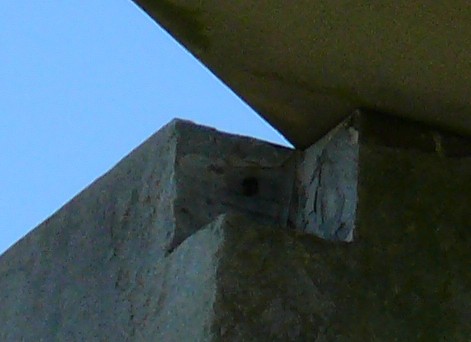
This is NOT the cube that was removed in 2009, it’s a fake. It doesn’t even have the peggings. By peggings I mean the pegs that jutted out from the original 1st cube. They were used to guide the original 1st cube into place and help hold it while the adhesive dried. Look at this picture:
You can see the peg holes and the remnants of the adhesive. The whole sat open like this from 2009 until 2014.
In 2014 the infamous 2nd cube appeared. Elberton authorities claim they don’t know how it got there. Were the deputies not watching the cameras? They can supposedly catch three men trying to replace a cube in 2013, but not someone else doing it again in 2014? Hard to believe, because it’s a lie. Anyway, the 2nd cube was removed and destroyed on 9/25/14. This was a few weeks after it was first “discovered” and shown on various social media outlets, enough time to be sure its appearance would be known. That way its disappearance would cause a stir. Again, social media, to get the information on the cube out to those who know how to read it worldwide. Now, I am sure you’ve seen the video. Like the WSGC article, the destruction video is a fraud. Pertinent questions quickly came to mind.
How did all those people know that the 2nd cube was going to be removed that day, and yet not a single actual news crew showed up? No reporters, no official cameras. Instead we are treated to a single video recorded off what appears to be a young woman’s smartphone. The man who climbed the ladder and removed the cube. How did he know that he wouldn’t need tools to remove it when he climbed the ladder? Why did the girl have all the time she needed to record all sides of the cube, without the officer making her step away from the evidence? And why did the ladder man bring the tools he needed to destroy the cube ahead of time? All of these questions are answered easily and obviously. This was a planned extraction for the purpose of information dispersion and
cover up. Those who needed to see the sides of the cube (Freemasons) were able to do so through social media. The rest of us were lead to believe the 2014 cube was unwanted by Elberton county and was thus destroyed. Destroyed evidence with no culprits even mentioned as targets of investigation? Sounds fishy because it’s a red herring. I’m sure it’s of no surprise to you that most of the people involved in this recorded scene were masons.
People first assume this is a date of 8/16/2014. That’s because they read the cube in the wrong direction. They are reading the cube spun clockwise. This is wrong. Remember the guidestones make a big deal out of Polaris. And viewed from Polaris the Earth turns counter-clockwise. The cube date read in this direction becomes: 8/14/2016
This is important for two reasons. The obvious being that unlike 8/16/2014, 8/14/2016 hasn’t happened yet. But more importantly, August 14th is a day that means a lot to Freemasons. They HATE that day and for good reason. The first true public enemy the Freemasons had was William Morgan. Long story short, this man had access to secret Freemason rituals and materials and planned to make them public. He planned to expose the Freemasons via a book called “Illustrations of Masonry, By One of the Fraternity Who Has Devoted Thirty Years to the Subject”. He obtained a copyright for this particular book on August 14th, 1826. Shortly afterwards he was murdered by Freemasons. This led to the Morgan affair which led to the Antimasonic Party. To this very day, Freemasons loathe the date August 14th. They see it as the point at which society at large turned against them. What better day then, for the Freemasons to enact their revenge? To turn against society? And thus we have the date of the 2nd cube being: 8/14/2016.
But what of the letters MM and JAM?
MM stands for Master Mason. No surprise. Lots of people figured that one out.
Nobody figured out JAM. I guess no one studies Latin anymore?
JAM stands for Judicie Anno Mundi. “In the judgment of the world.”
Judgement day.
The 2nd cube tells those who can read it that the Master Mason will bring Judgement Day on 8/14/2016.
This is the extent of information that I can tell you. Research the things I’ve said, you will find all of it true. I leave this upon you and one other soul to decide what to do with all this information. Good luck and bless you as an agent of truth.
From here on out, I do not exist. We will never speak again.
In 2009 when my girls and I originally visited the Georgia Guidestones for what turned out to be my initial article on the subject, I discovered a large notch cut out of the top-right corner of the English language Guidestone. Given the considerable amount of vandalism committed over the year prior to our visit, I assumed that the notch was an attempt to topple the monument by freeing the English language Guidestone from the large stainless steel pin securing it to the capstone.
Mart Clamp, whose father sandblasted all of the letters and hieroglyphics onto the granite slabs 30 years previously from that visit, was chiseling away two-part epoxy that had been thrown onto the controversial monument in a recent act of vandalism. I asked Mart about the notch, but he said that he did not know anything about it.
I could find no previous photographs of the notch even though I found photographs taken by other visitors to the site earlier in 2009. Additionally, I found the following video from December, 2008, posted by an anonymous vandal. The notch is not visible on the English language Guidestone at the time of the video.
Elberton Star publisher Gary Jones is a local expert on the granite edifice. While interviewing him in 2009 about the Georgia Guidestones, I mentioned the notch. Gary was not aware of the notch at that time and he told me that he would report my information about it to the local authorities.
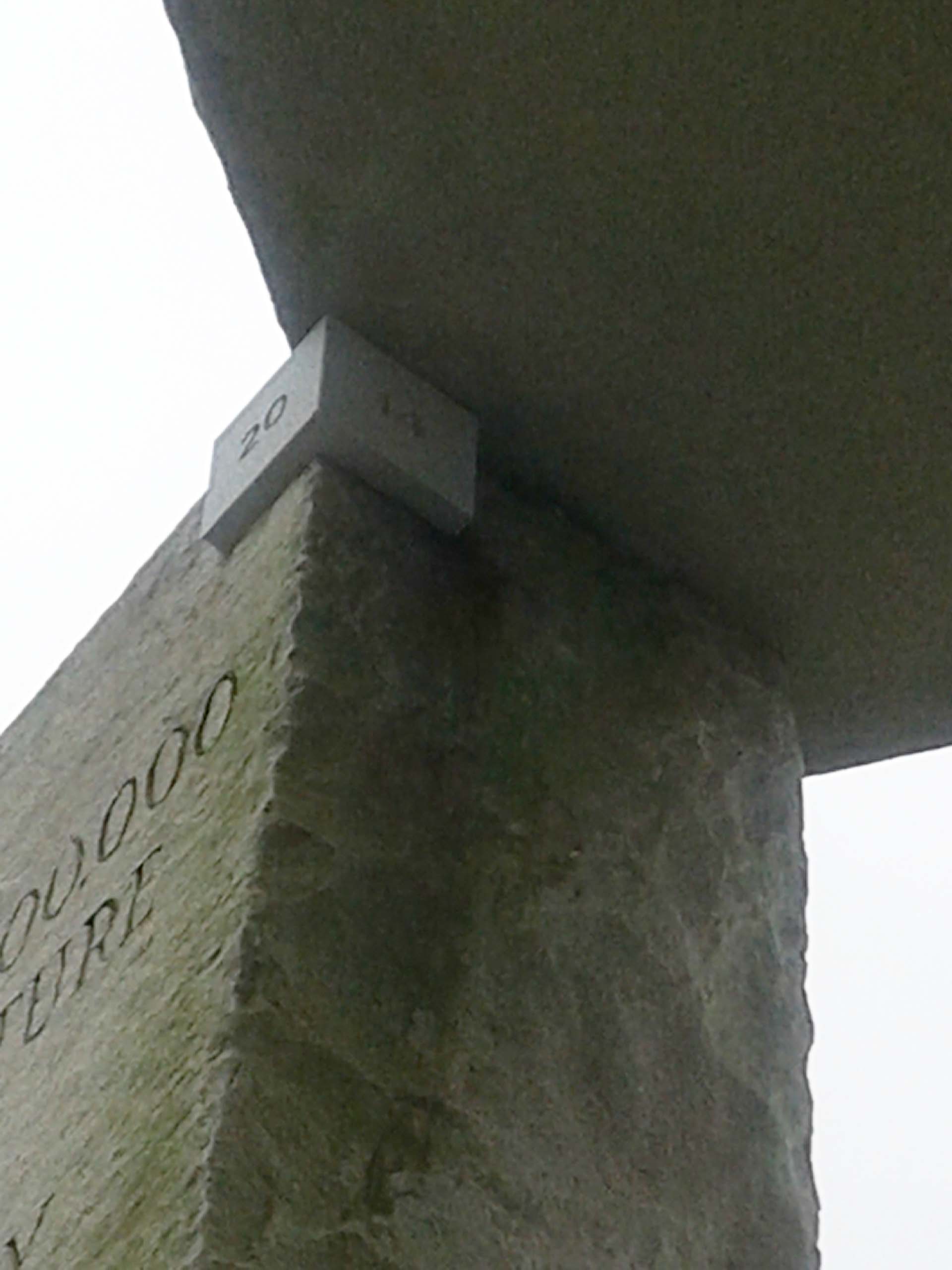
On September 11, 2014, I was contacted by a reader, Brian, who had recently visited the Georgia Guidestones. He said that the notch had now been filled with a granite cube etched with the numbers “20” and “14” on the two exposed sides of the cube. Brian sent me the two photos below.
I contacted Gary Jones about the newly added cube and he passed along the information to the Elbert County Sheriff’s Department. Whoever placed the cube into the notch did not do it as part of any officially sanctioned activity. It will be interesting to see if the block is removed in the next few days.
The cube appears to be professionally created out of a type of granite similar to the Pyramid Blue granite used to construct the Georgia Guidestones.
Mart Clamp, owner of Clamp Memorials, has the tools, materials and expertise necessary to manufacture the block. When I first met him five years ago, he was chipping away at the monument with a hammer and chisel almost directly underneath the newly created notch, as you can see from the first photo in this blurb. I have tried to contact Mart about the block, but to no avail yet.
“My long-term goal is to build some sort of festival around it, something that would be a weeklong thing that could be held in two or three different spots around Elberton that could really draw in crowds and help the local economy,” Mart said in a New York Times piece published about a year ago.
Given the overt and explicitly apocalyptic nature of the Georgia Guidestones, it is understandable that many people have already expressed alarm over the recent addition to the monument of new component bearing what certainly appears to be the current year. War, social unrest, ebola and global chaos have many people on edge.
Interestingly, the word “Isis” was scribbled all over the monument at about the same time that the “20 14” cube appeared inserted into the Guidestones’ notch, a notch that had been vacant for five years. The mention of “Isis” alarmed local authorities enough for them to contact the FBI, according to a local news report.
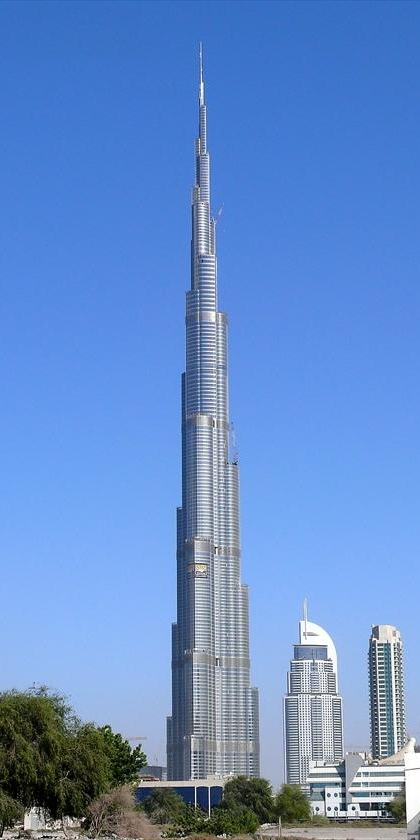
Our initial analysis of the monument five years ago demonstrated a link between it and the Burj Khalifa, the tallest building in the world. In fact, our analysis introduced the words “caliphate” and “Mahdi” long before they became mainstream with the emergence of ISIS. ISIS declared a caliphate early this summer. And the occult overtones of “ISIS” are obvious.
You can see all of our Georgia Guidestones research here.
The Georgia Guidestones have been a source of debate for decades. Our research links the controversial granite monument with the world’s tallest building, the Burj Khalifa, confirming the suspicions of some that the Stonehenge-like structure declares the planning of a global government and the culling of the world’s human population to a mere 500,000,000.
While the monument has provoked heated arguments for many years, it was only with our recent articles that it has become widely known that a book was written by the architect of the Georgia Guidestones expounding upon the foreboding ten commandments etched into the eight faces of the edifice in eight different languages. This book, Common Sense Renewed, was delivered upon initial publication to every member of the United States Congress, but has become almost impossible to obtain after our disclosure of the existence of a small inventory of the tome in Elberton.
However, reader J. Leonkoro posted a comment today to our brief article Obtaining ‘Common Sense Renewed’ that contains a link to a scanned PDF of the book. That link is here:
I have downloaded the PDF and it appears to be complete. The file also contains additional material relevant to understanding the book as well as photographs of the leather, hardbound copy used for the PDF file.
Interestingly, the book is hand enumerated as copy 96 of 100 and is signed “Robert Christian.” Handwriting experts might find it fruitful to compare the signature with Ted Turner’s.
More information about the sinister Georgia Guidestones can be found here, here and here.
A pastebin post self-attributed to the secretive and nebulous activist group “Anonymous” claims that a 9/11-style false flag attack on the Los Angeles Citibank building may occur tomorrow, Friday, November 15, 2013. The post is quoted in its entirety below:
Potential False Flag———————————-Anonymous Shocking Current Events
Greetings citizens of the world, we are Anonymous. We have received intel related to the possible destruction of one of downtown Los Angeles’s towers, being set up as a false flag event on Friday, November fifteenth two thousand and thirteen. Over the weekend, SWAT teams were conducting drills in downtown Los Angeles unlike any completed in the past. The Citi Bank building that is currently occupied by Freddie Mac just recently dropped all insurance policies except for the policy portion which contains special conditions, coverages related to terrorism, which is all risk of direct physical damage. The certificate holder for this policy is located at 444 South Flower Street, Los Angeles, California 90015, under Hines Vaf, a private insurance company which offers Loss Adjusters, Allstate Claims Adjuster, Integrated Insurance Services, Property Insurance Adjuster and General Auto Insurance. Similar to the destruction of the twin towers, changes were made to their insurance policies prior to the so called terrorist acts on nine eleven. Although we are not one hundred percent sure of these horrific activities being planned to transpire within the next few days, we did not want to take a chance and risk losing anymore innocent lives and have a repeat of nine eleven in New York. The buildings in question are the Citi bank building which is located adjacent to the US bank building on the corner of South Flower and West Fifth street. It is believed to be the target for a false flag event set for this Friday. We ask American citizens who work in this area of Los Angeles California to take extra precautions. It is advisable given the severity of this information, if you are employed and are working, or conducting personal matters in either the Citi bank or the US bank towers of los Angeles, that you stay away from these two structures on that day. This is a warning, and again, as a precautionary measure we alert you of this possible false flag event being set up in the city of Los Angeles. To the share holders of these policies, you have been warned. We do not forgive, we do not forget. Expect to be held accountable for your actions if you follow through with your sinister agenda. We will not tolerate your wicked greed in pursuit of more wealth and restructure. We are Anonymous. We do not forgive. We do not forget. Expect us.
——————————————————————————————————————
Adding some level of weight to the Anonymous warning, the Georgia Guidestones, an occult monument that we have discussed in detail on this website and in radio and television interviews, may have tomorrow’s date encoded into it.
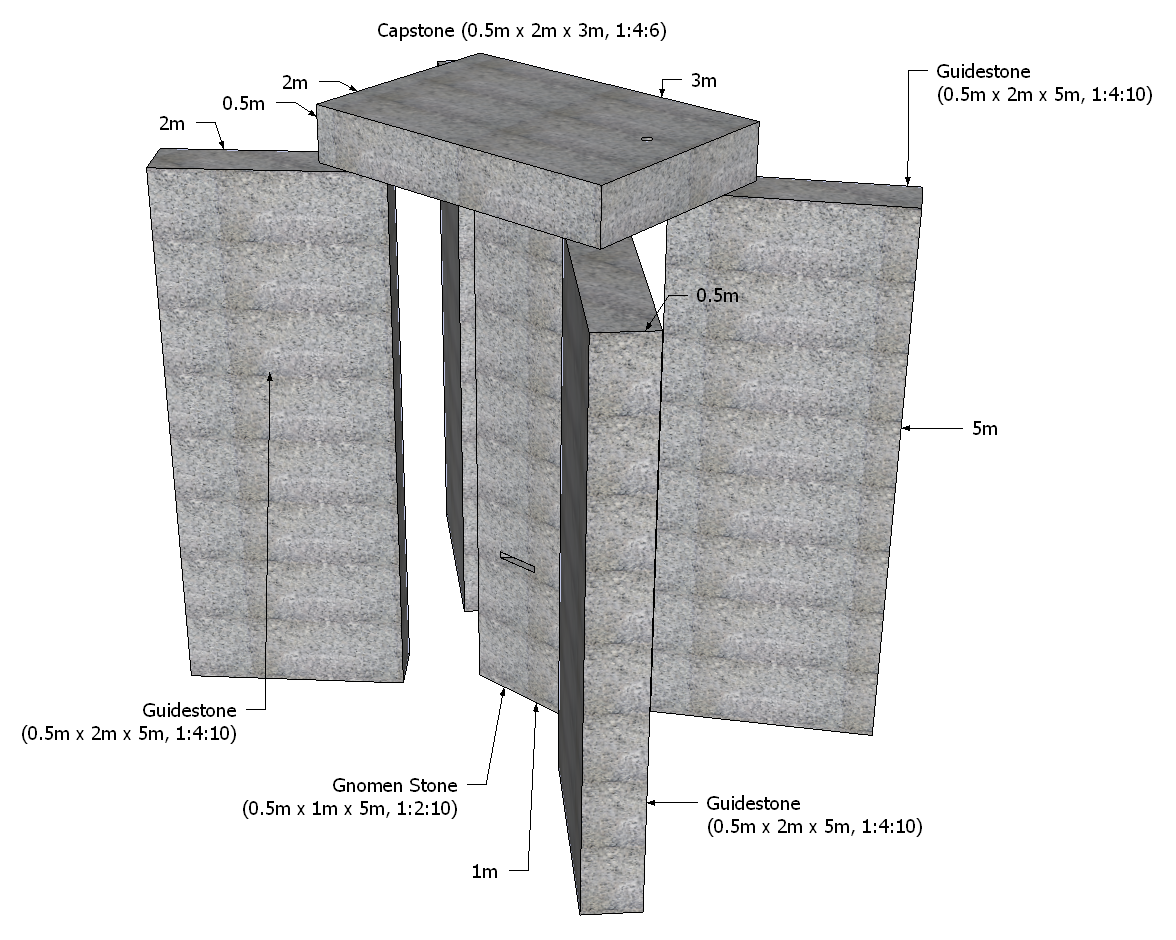
The metric measurements for the granite monument specified by the monument’s architect, a mysterious man who used the pseudonym “R.C. Christian,” were:
Capstone: 0.5m x 2m x 3m
Center “Gnomen” stone: 0.5m x 1m x 5m
Each of the four Guidestones: 0.5m x 2m x 5m
The corresponding proportions then become:
Capstone: 1 : 4 : 6
Each of the four Guidestones: 1 : 4 : 10
Center “Gnomen” stone: 1 : 2 : 10
Adding the proportions for each component:
Capstone: 1 : 4 : 6 = 11
Each of the four Guidestones: 1 : 4 : 10 = 15
Center “Gnomen” stone: 1 : 2 : 10 = 13
This leads to the date 11/15/13, which is tomorrow, the Friday indicated by Anonymous.
You can read more about the astounding and disturbing numerological links encoded in the Georgia Guidestones here, here and here.
I find myself suddenly in a dark pit, illuminated only by scattered fires and glowing lava pools. I fumble with my phone, but there are no bars. I start recording…
Me: Wow, it’s hot! And what is that smell?
The fiery pit is large and barren of life. Despite the overwhelming heat, the center of the pit appears to be frozen and covered in ice.
I search through the dense, noxious vapors when suddenly I am startled by an old, filthy, bent, solitary man in rags standing in a mist and staring upwards towards the center of the pit.
Old man: The odor is a mix of sulfur and decomposition. And it’s always hot in Hell.
His descriptions seem melodramatic, but they certainly fit. I slowly work my way towards the wretched figure.
Me: Who are you?
Old man: I am the great Greek philosopher, Plato.
Out of courtesy and pity, I attempt to conceal my skepticism. I smile at the old man, but he continues to look away.
Me: If you are now in Hell, then I’m not sure you were such a great philosopher when you were alive.
Momentarily irritated by my comment, Plato continues in a practiced, haughty tone.
Plato: Transformed into icy granite, I am frozen for eternity with my gaze fixed upon my master.
I look around and see no one else in view.
Me: Who is your master and where is he? I don’t see anyone else here but you and me.
Surprised by my questions, Plato indignantly responds with a booming, though trembling voice.
Plato: My master is none other than Lucifer himself! Bow to his magnificent beauty as he towers before us with majesty and power in the center of this very pit.
I carefully follow the old man’s gaze towards the frozen center of the pit. It is empty, save for a large pool of ice.
Me: Sir, you are mistaken. There is no one else here in this Godforsaken place besides you and me.
Plato is unsurprised.
Plato: You lack discernment.
I won’t argue with him there, but I cannot help but begin to question his grasp on reality.
Me: You are also not made of stone. Here, let me help you sit.
I step towards the miserable figure when he suddenly erupts, halting my progress.
Plato: No! It is you who are wrong! Do you even know what today is?
Me: It’s November 6, 2012, Election Day in my country.
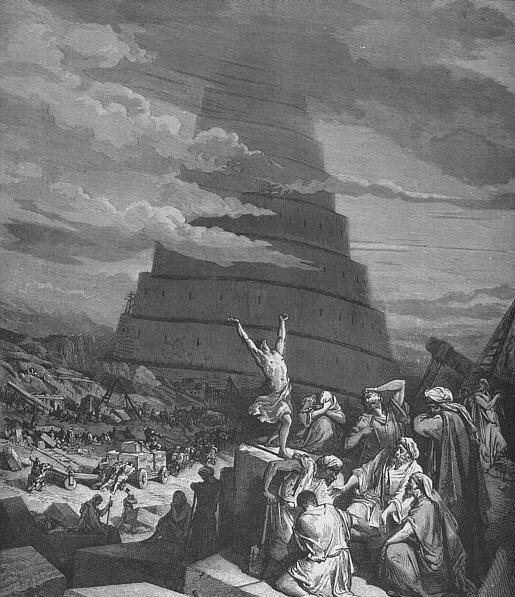
Plato: By the numbers it is 11:6, a day for the occult invocation of the uncompleted Tower of Babel. The old order was torn down on 9/11/01 — 9/11 is an inversion of 11:6 — the Tower was completed anew on 1/4/10 and the final chapter before the birth of the New Order starts today, 23 days after my master fell to Earth a second time.
Numbers. The occult loves numbers like 2,717, the secret height of the Burj Khalifa, which I had derived directly from the proportions of the Georgia Guidestones months before the Burj’s true height was publicly known. 2,717, the first Greek number skipped in Strong’s Numbers for the New Testament, a number that some say foreshadows the Antichrist, a number that corresponds to “make waste” or “to be made desolate” in the Strong’s Hebrew Concordance.
One of the most diabolical examples of Georgia Guidestones numerology involves the Magnitude 9.0 Tōhoku, Japan, earthquake that claimed nearly 16,000 lives. This massive disaster struck Japan on March 11, 2011, exactly 11,311 days after the Georgia Guidestones monument was officially completed on March 22, 1980. The number “11,311” in day/month/year format (“little endian,” which is most commonly used around the world) or year/month/day format (“big endian,” which is used by the military and also in Japan) can be written 11/3/11. This corresponds to March 11, 2011, the actual date of the earthquake.
Furthermore, the earthquake occurred exactly 9 years, 6 months after 9/11/2001. Treating these dates as vectors and adding them together we get: [ 9, 11, 1 ] + [ 3, 11, 11 ] = [ 12, 22, 12 ] or December 22, 2012, the day after the end of the Mayan calender, or, more appropriately, the first day of a new age.
However, regarding the old man’s last assertion, try as I might, I cannot contain my laughter.
Me: Are you saying that Felix Baumgartner is Satan?
Plato: Fool! Ceremonies on the mortal plane open portals within the spiritual realm. You claim to be an expert on the Georgia Guidestones, so how many days will it be since the day the monument was completed until December 21, 2012, the Mayan Day of Destruction?
I’m startled that he seems to know who I am.
Me: It would take me a few minutes to figure that out with no computer here. My phone has no signal…
Plato: You should already know the answer. It’s 11,962 days. Does that number look familiar to you?
Me: No. Let me think; I have an app on my phone that might help. 11,962 is an unusual number since it has only two prime factors: 2 and 5,981. Why should I know more about it?
Plato: Your country uses many codes, this is one of them.
Me: Codes? Yes, it does look like a Zip Code, but I have no idea what community it corresponds to.
Plato: It is the code for Sagaponack, New York.
Me: Really? I recall Sagaponack was listed as the most expensive small town in the country. The median house price in Sagaponack is over $4-million! I think Jimmy Fallon lives there among the 500 or so residents; it’s a tiny place.
Plato: Who?
Me: Jimmy Fallon. He is a comedian who appears in credit card commercials trying to convince a baby to take money. The baby keeps throwing the money back in his face.
Plato laughs uncontrollably for several seconds before recovering himself.
Plato: And you still do not understand? You are being mocked, ridiculed! That baby has more wisdom than you!
Me: I guess I do not understand. Please explain.
Plato: Sagaponack is the home of Lloyd Blankfein…
I turn white and my stomach tightens.
Me: You mean the CEO and Chairman of Goldman Sachs?
Plato: Yes.
Is December 21, 2012, a financial doomsday that will bring down the world’s nations, or does it have some other significance? You need to answer that question yourself. What I will tell you is that The Georgia Guidestones, 9/11, the Burj Khalifa, Ted Turner, Goldman Sachs, the Mahdi, today’s elections, earthquakes, storms, riots and the war to come are all part of the same ceremony that balance on the fulcrum that is the date December 21, 2012. And it is all made possible through an illusion. Your money holds no value, but its illusion of value has been maintained by your world’s insatiable love for base, material things.
The moneychangers are the rulers of your world and now they plan to bring it all down through a final series of Grand Illusions. They will wipe the Earth clean, disposing of billions of human lives, and, using the benefits of high technology, erect a New World Order for their master, Lucifer. This New World Order is a society I designed thousands of years ago; I am the architect.
My head spins with this information. It is hard to dispel, but I don’t want to believe it. If all he says is true, then a supreme irony is that at least part of the Georgia Guidestones project was not funded by money, but rather paid for with gold. Last summer, my wife contacted the publisher of Common Sense Renewed, the companion book for the monument. The aging publisher told her that the book was paid for anonymously using South African Krugerrands, gold bullion coins. More ironically, the publishing company is located in Mason City, Iowa, a town founded by Freemasons.
I reach out my right hand to help the old man sit, but I slip on the icy ground and grab his arm for support. His arm is frigid and hard and unyielding like rock. I look at his face closely for the first time and his eyes are gone, clawed from their sockets. The life I saw in him has vanished and his form has been replaced by a crudely hewn granite statue.
I step back in terror when I am suddenly gripped with pain in my right hand. The color drains from it and I can no longer move my fingers. Out of the corner of my eye, I notice a massive figure looming overhead. Unmistakeably, it’s winged Lucifer, frozen in the center of Hell.
But he’s melting and his huge head pivots towards me. I recognize him! How could I be so stupid not to have known sooner? I must warn everyone before it’s too late!
But I can’t move. My feet have turned to stone as has most of my body. I only have a few more seconds before I’m completely rendered in granite. Maybe if I shout loudly enough, someone will hear me.
Me: Lucifer walks the Earth again! His name is…
========================
For more on the sinister Georgia Guidestones monument, please see here, here and here.
Analysis, OpinionsComments Off on Facebook to become basis for National ID?
Aug212012
Many of us inside the computer industry were highly skeptical of Facebook’s IPO. I warned those near me that Facebook (NASDAQ FB) was grossly overpriced and would crash so hard, so fast that it might serve as a bullet in the head for the struggling global economy. It’s not just that Facebook’s market cap has sunk from $100-billion to $48-billion since the May 17th IPO, a short three months, but that Facebook was loudly trumpeted as the “face” of a recovering American economy.
Consequently, as Facebook tumbles, so falls public confidence in an improving U.S. economy.
Given the size and importance of Facebook, it is increasingly likely that the American Government will intercede to bail out the collapsing tech company. With Facebook’s earliest investor, Peter Theil, dumping most of his shares last week, the bailout might be at hand very soon.
Interestingly, while Facebook’s growing popularity is losing steam almost as fast as its stock price, several mainstream articles have appeared recently positing that a Facebook presence might soon become required by employers. UK’s DailMail went as far as to write, “Is not joining Facebook a sign you’re a psychopath? Some employers and psychologists say staying away from social media is ‘suspicious’.”
Additionally, last March a controversy erupted after media reports of a few employers who began requiring Facebook login IDs and passwords from job applicants and even current current employees for screening and monitoring purposes. Schools and universities were also cited for demanding full Facebook access from students, prospective or current.
With the Feds directly overseeing Facebook, the Government could generate reports for each Facebook user, preserving personal details while scoring the user across various vectors of trustworthiness. In a real sense, the U.S. Government would serve as a Big Brother who would vouch for you.
Two years ago we wrote that TSA’s growing intrusiveness in airports might be a deliberate attempt by the U.S. Government to soften public resistance against a National ID initiative. Perhaps the plan is to use Facebook for that system. With Homeland Security oversight after a Government takeover, Facebook might serve as the basis of a comprehensive and invasive national identification registry.
The sleeve for a popular record album from 1979 contains graphics elements that suggest foreknowledge of the tragic September 11, 2001, terrorist attacks on New York City.
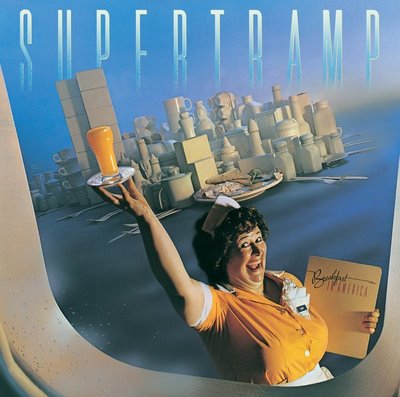
The number one pop album during the summer of 1979, Supertramp’s Breakfast in America, the band’s sixth album, was released on March 29, 1979 (the Georgia Guidestones monument was completed 360 days later on March 22, 1980).
Next stop was Studio B at the Village Recorder in West LA, housed within a Masonic temple and featuring a 48-channel Harrison console, as well as two Ampex 1200 24-track machines. The band members all gathered there on the first day, yet Peter Henderson didn’t show — while driving to the studio from Topanga Canyon, he and his new wife were involved in a head-on collision with a drunk driver. Fortunately, nobody was too badly injured, and Peter eventually turned up at the Village Recorder with two enormous black eyes. “I looked like I’d been in the ring with Muhammad Ali,” he says. “It wasn’t the best of starts, but we were very lucky to get off so lightly.”
The album’s cover received the 1980 Grammy Award for Best Recording Packaging. The front cover bears an aerial view of the New York City skyline as seen from an airliner passenger window above the Statue of Liberty; however, the buildings are recreated using kitchen items and Lady Liberty is a diner waitress named “Libby” holding a glass of orange juice on a platter in place of a torch. The cover can be seen below (image courtesy Wikipedia).
The album cover for Supertramp's Breakfast in America
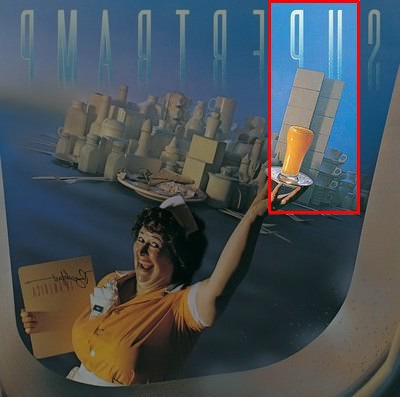
Reflecting the image yield’s the following:
Not only does “Libby” appear to be drawing attention to the Twin Towers, but hovering over the Towers is the number “911.” This bizarre and apparently intentional aspect of the Supertramp record sleeve was first reported on QFF.
Chevrolet has uploaded to YouTube a 2012 Super Bowl advertisement for its popular Silverado line of pickup trucks. Based in a post-apocalyptic world foretold by the Maya, the ad shows a surviving Chevy Silverado emerging from the rubble and driving past a series of end-of-the-world disaster movie cliches while Barry Manilow’s Looks Like We Made It plays in the background. At first glance, the commercial appears to be clever and funny. However, it contains much more subtle and diabolical occult symbolism. The commercial can be viewed below. It is best watched in full screen, HD quality so that all of its details can be seen.
The white truck eventually meets with three other Chevy pickups. The Red and Black trucks appear to be the same year and model as the white pickup, while the fourth truck is a much older, beige Chevy. The four drivers represent the Four Horsemen of the Apocalypse, the destructive forces of Conquest, War, Famine and finally Death, all unleashed by the Lamb, Jesus Christ, in John’s Book of Revelation.
The driver of the white truck has a dog in his backseat wearing a harness that resembles the clothing of the Rider of the White Horse in Victor Vasnetsov’s painting. The Rider of the White Horse represents Conquest. Some see him as the Antichrist, others as the Islamic Mahdi. Of course, some people consider the Mahdi and the Antichrist to be the same person.
The driver of the red truck represents War and he announces the death of “Dave” a possible reference to King David’s people, the Jews.
The driver of the black truck is a black man holding a box of Twinkies which he offers to the driver of the white truck. He is the Rider of the Black Horse and represents famine. Hostess, the maker of Twinkies, filed for bankruptcy last month (see here).
The slim man wearing a grey jacket who drove the old stepside Chevy (that resembles an aging, emaciated horse) is silent. He represents the Rider of the Pale Horse who is Death, the last of the Four Horsemen.
The scene switches to an overhead camera showing a seated fifth man, initially almost invisible, who is holding something that he has been reading. He represents Christ, the Lamb, who can be seen next to a book in the background of Vasnetsov’s painting. Christ unleashes the Four Horsemen of the Apocalypse when he breaks four of the seven seals of God’s scroll initially held in God’s right hand. Near this seated man is a triangle, showing his relationship to the Trinity as Jesus.
At the end of the ad, frogs begin to rain from the sky yet the five men maintain their positions at the five points of a pentagram.
There are several other symbolic references in the advertisement, some serious and some not. For instance, the newspaper features a Mayan pyramid with an eye-like glow above it, recreating the famous Illuminati symbol found on the back of the U.S. one dollar bill. There are also homages to a few popular computer games. However, the occult meaning of the commercial clearly is the arrival of the Four Horsemen of the Apocalypse and this message is not meant to be clever or funny, but is consistent with our research into the Georgia Guidestones and the arrival of the Mahdi.
Analysis, ScienceComments Off on Comet Lovejoy plunges towards Sun
Dec152011
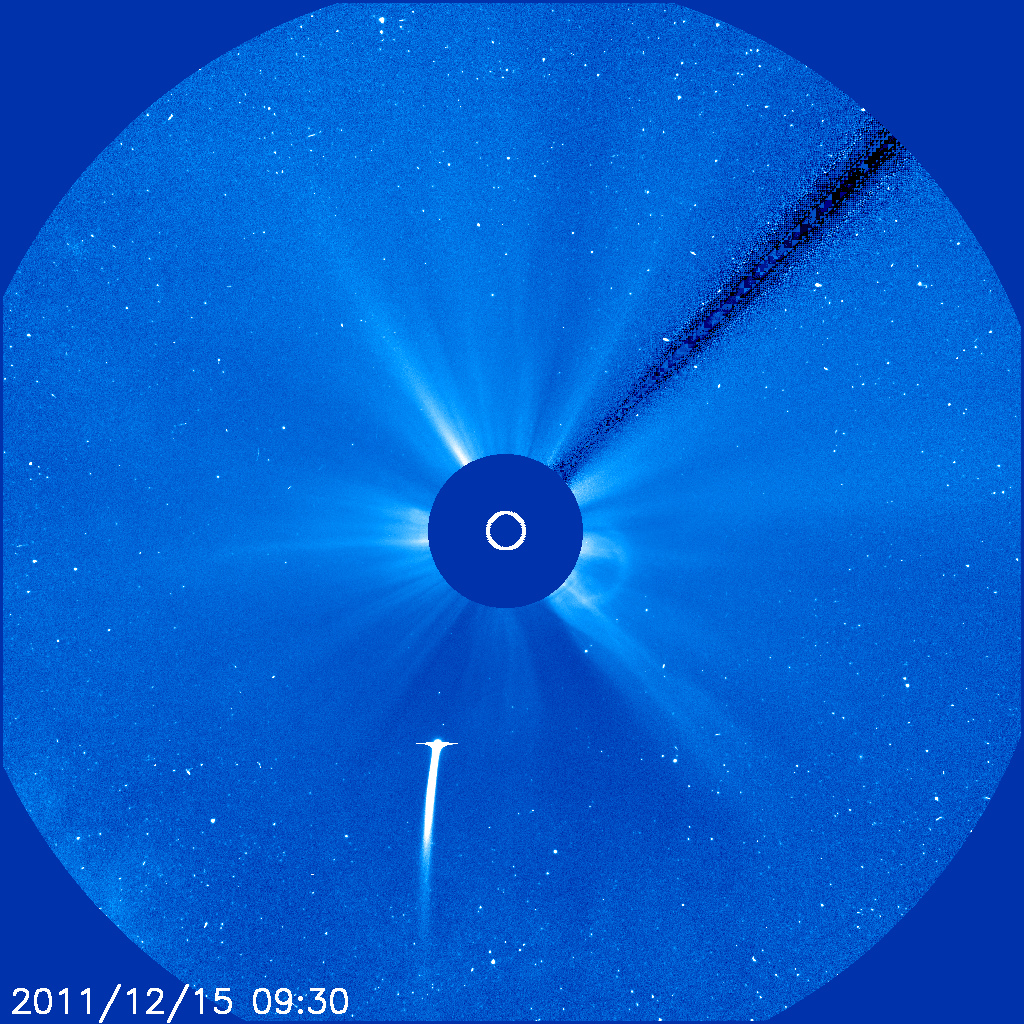
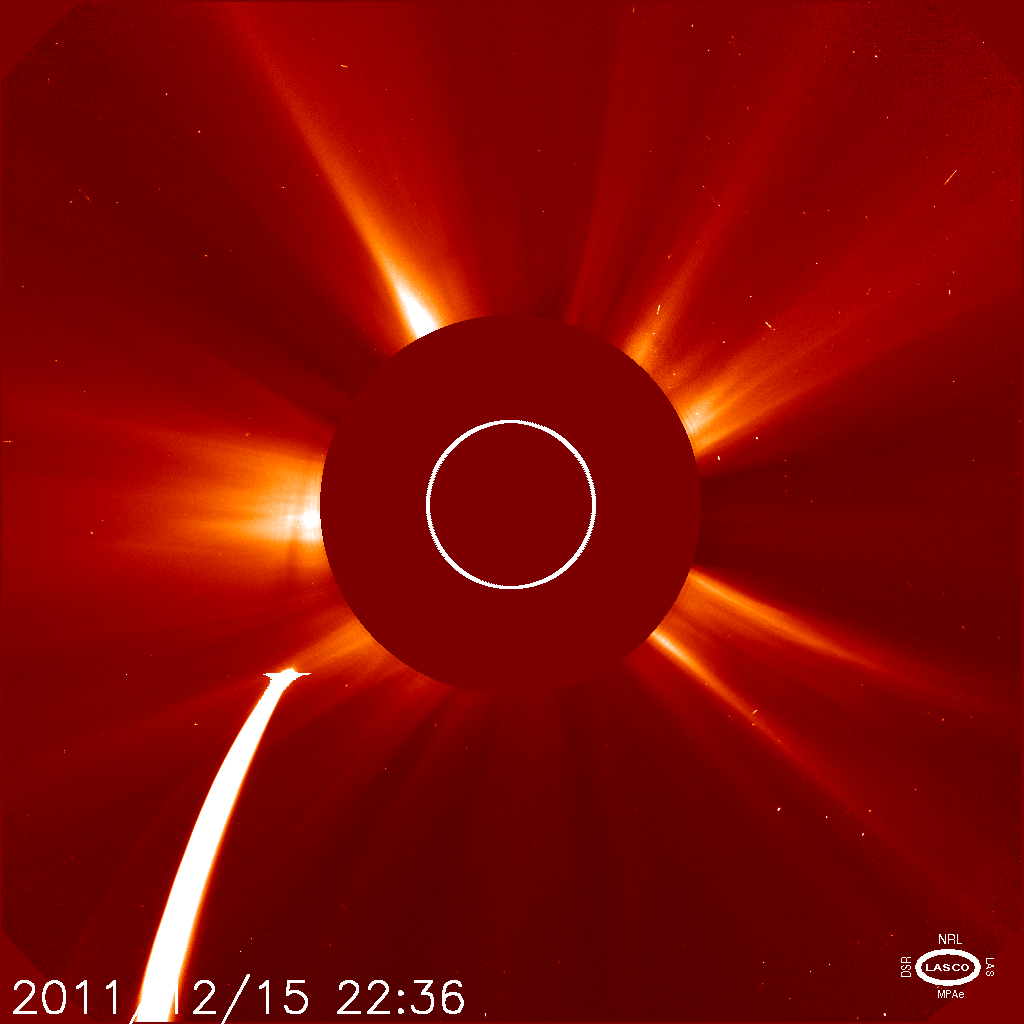
In what could become the most spectacular solar event of an already eventful year, Comet Lovejoy (C/2011 W3) is racing towards solar doom today. With a coma that appears to be larger than Jupiter and with a tail stretching for tens of millions of miles, Comet Lovejoy is the first sungrazing comet observed directly from earth in over forty years. Discovered using a CCD-equipped telescope by Terry Lovejoy on November 27, Comet Lovejoy appears to be a member of the Kreutz group of sungrazing comets that have put on some of the most magnificent shows in recorded history.
There is even a possibility that Comet Lovejoy will be visible for a short time in broad daylight.
Technically, Comet Lovejoy is projected to come about 0.1 solar diameters from the Sun’s plasma surface (photoshere) at about 6 PM Central, but in reality the comet will almost certainly perish, perhaps spectacularly. In any case, Comet Lovejoy will likely outdo October’s amazing cometary solar impact event.
As with the October event, look for a resulting coronal mass ejection (CME). Quoting our October blurb:
Conventional astronomical theories cannot account for the violent solar reactions to these two impacts because neither body had sufficient mass or speed to violently blast significant amounts of ejecta millions of miles away from the sun’s surface. However, proponents of the Electric Universe predicted such behavior. According to them, comets are like giant capacitors that become highly electrically charged due to their eccentric orbits around the sun. When they plunge through the inner solar system, the dense solar winds trigger plasma discharges resulting in the tail and coma of the comet. If there is any truth to this idea, it is easy to imagine how a comet impact could disrupt the local magnetic field of the sun and result in a CME.
And if the CME is big and earth directed, be on the lookout for earthly consequences like auroral displays and even earthquakes.
Deposed Libyan leader Moammar Gadhafi was reportedly killed today. While members of the United States Government celebrate his killing, this video depicts a very different man and a very different Libya than the demonized images seen in mainstream media over the last year.
The simple fact is that we do not have to struggle and suffer the way we do today in most modern countries. The costs of goods and services necessary for living are artificial constructs. Through inaction and tacit acceptance of these illusions, we are complicit with our own enslavement. While many people mumble protestations at the news, through our inaction we also share in the sins of our nations.
Our country has lost her way. We have been overtaken by greed, a thirst for blood and carnal distractions. We have long since abandoned the high moral ground we once proudly held. We have turned our back on God.
Our airwaves are filled with frothing hate, increasingly ridiculous propaganda, examples of cowering impotence and shameful immorality. Simultaneously, we have allowed our government to constrict a police state serpent around our land, constricting all American citizens into virtual prisons.
But change is in the air, albeit woeful and painful transformation. The slaying of Gadhafi only a few days after U.S. Secretary of State Hillary Clinton stated that we look forward to his “killing” inextricably ties our country with his death. With ghoulish laughter, she proudly pronounced today, “We came, we saw, he died!”
And with the same voices clamoring for the toppling of Yemen, Syria and Iran, we are on the cusp of global war. Indeed, the slaying of Moammar Gadhafi might be the ember that lights the fuse for World War III.
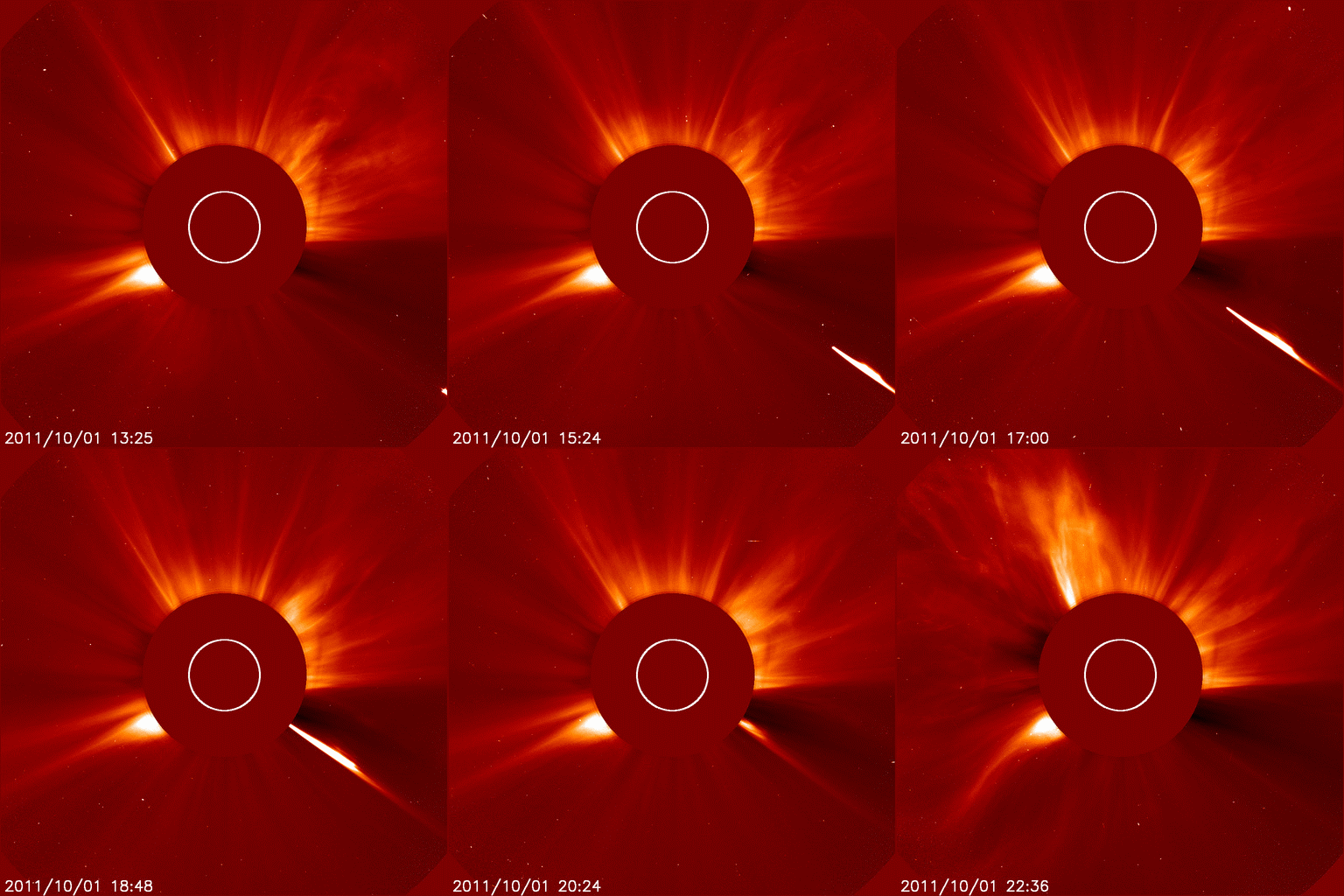
The largest cometary impact of the sun that I have ever witnessed occurred this weekend triggering a significant coronal mass ejection (CME). The animated GIF below shows the event.
A significant comet impacts the sun triggering a CME.
The coma of the comet was bigger than the earth (although the nucleus was certainly much less massive) and its tail stretched for several million miles. The comet streaked towards the sun at terrific speeds indicating a large, eccentric orbit. Further analysis of the comet’s motion shows an apparent slowdown as the comet neared the sun. In actuality, the comet continued to speed up as it swung around the sun, but did not quite clear the solar disk and smacked the sun on the far side, triggering the CME that erupted on the opposite side from the comet’s apparent approach in the animated GIF.
While some, like the bloggers at SpaceWeather, have expressed surprise in seeing the associated CME, this is not the first time that a comet has triggered a coronal mass ejection. A much smaller impact event occurred last May and can be seen in the YouTube video on our site here. Another similar collision that resulted in a more ambiguous CME can be seen on our site here.
Conventional astronomical theories cannot account for the violent solar reactions to these two impacts because neither body had sufficient mass or speed to violently blast significant amounts of ejecta millions of miles away from the sun’s surface. However, proponents of the Electric Universe predicted such behavior. According to them, comets are like giant capacitors that become highly electrically charged due to their eccentric orbits around the sun. When they plunge through the inner solar system, the dense solar winds trigger plasma discharges resulting in the tail and coma of the comet. If there is any truth to this idea, it is easy to imagine how a comet impact could disrupt the local magnetic field of the sun and result in a CME.
This is the second installment of a series of informal blog posts about these eminently important topics. You can read the first post here.
From all available scientific information, Comet Elenin is nothing special. In fact, it looks to be a boring, barely observable fizzy little conglomeration of rock and ice hurtling quickly through the inner solar system before vanishing beyond Pluto for another 11,800 years.
Certainly, Comet Elenin has not demonstrated any qualities that warrant the gushing torrent of panic that has flooded the Internet since the little comet’s official discovery last December 10th.
But one strange bit of evidence on the flip side of a bill of cash is so unambiguous that I have to admit that Comet Elenin might be worth an ocean of anxiety after all.
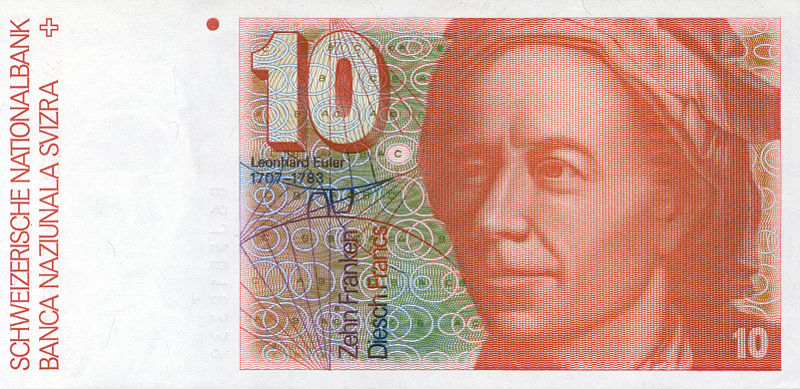
Towards the end of the last century, Switzerland distributed a peculiar ten Franc bill that honored the celebrated physicist, mathematician and defender of Christianity, Leonard Euler. The front of the bill looks typical of European denominations of the time, with Euler’s grinning mug offset to the right and a variety of esoteric, presumably anti-counterfeiting markings sprinkled elsewhere. Here’s an image of the front side of the note courtesy of Wikipedia.
10 Franc Swiss note honoring Leonard Euler
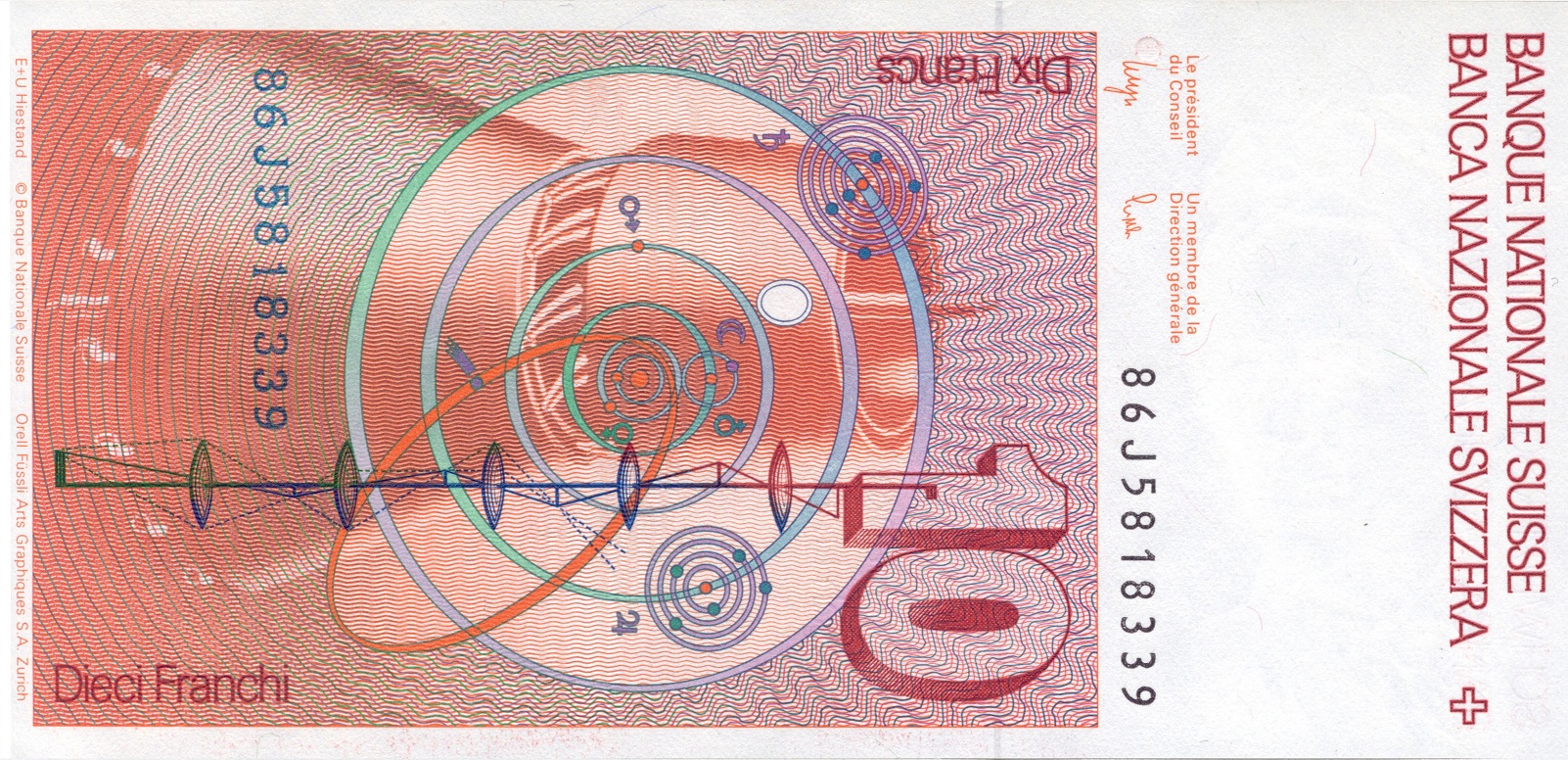
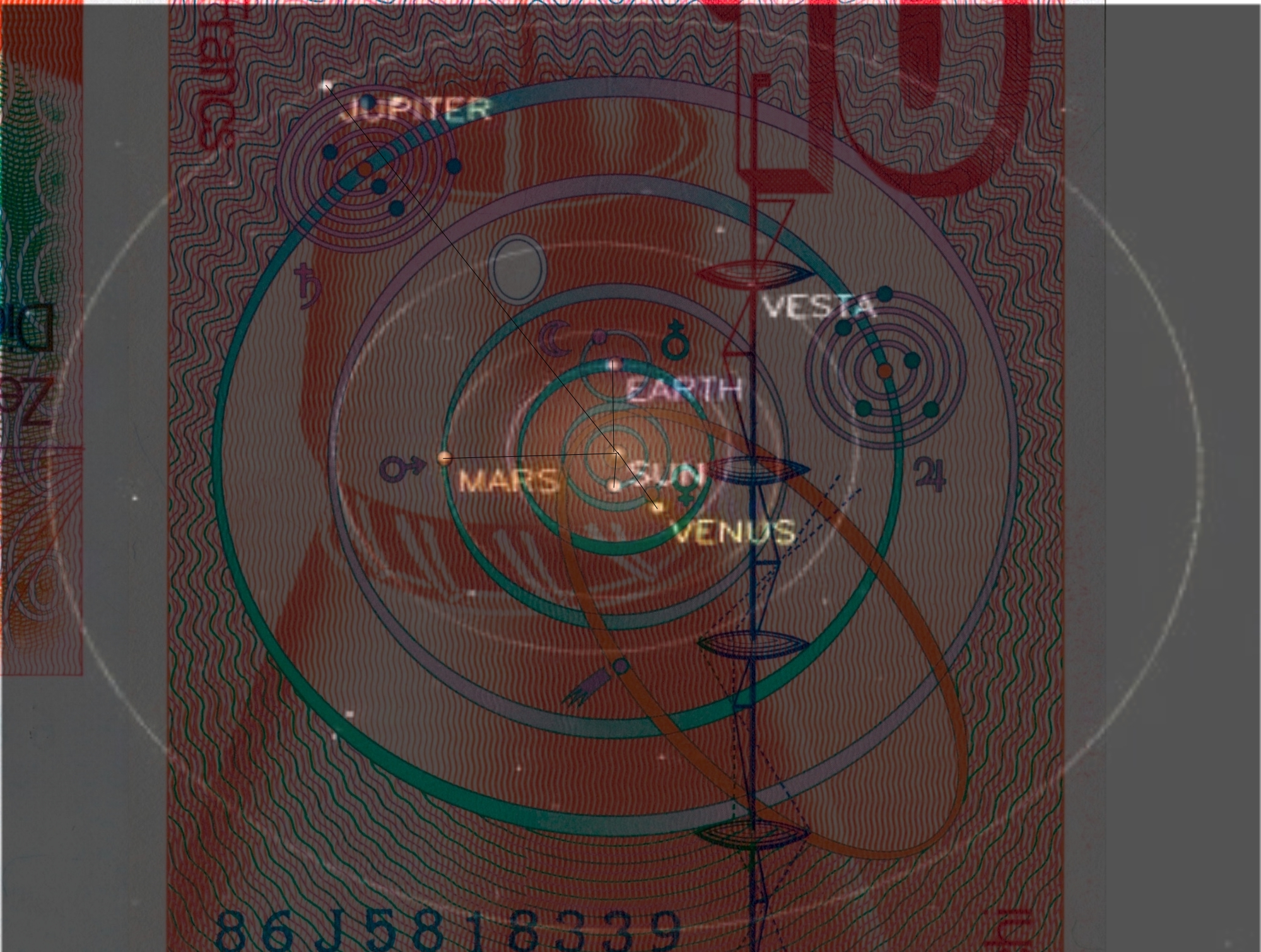
However, like the rapidly shrinking U.S. One Dollar slip of fiat currency, the obverse side is odd and contains much more information than first meets the eye. The back of the Euler note is dominated by a diagram of the Solar System with a comet streaking through it. That alone is not really peculiar because Euler drew a chart quite similar to it. However, the positions of the planets are very interesting. Take a look at this image that came from the University of Princeton.
The back of the Euler note
A small part of the Comet Elenin hysteria was discussion about how the planets in the diagram seem to conform with the date September 26, 2011, the very day that Elenin passes between the Earth and the Sun (although a little above the ecliptic). Given how totally wrong the vast majority of insane Comet Elenin jabber has been, I didn’t expect to find much correspondence with reality until I overlaid the September 26 orbital projections of the planets from the JPL Solar System simulator onto the Swiss bill. Take a look:
JPL Solar System projection over the Euler note
The alignments for Mercury through Mars are spot on. While it looks like Saturn and Jupiter are out of place, the orbits on the bill are drawn close to scale and the two outer orbits align closely to the asteroid belt and Jupiter. Assuming the outer planet is actually Jupiter instead of Saturn, the alignment is only a degree or two off. (Oddly, the moon is roughly 180 degrees out of place, though.)
I knew immediately that such alignments were very rare, but I wanted to quantify the period between such alignments so I wrote an orbital simulation. To my amazement, it takes about 1,696,039 years for the planets to reach the depicted positions within a margin of error of +-10% for each planet! However, the planets on the back of the Euler note are far more precisely oriented than that.
What this means is that the back of the Euler banknote is an intentional encoding for the date September 26, 2011. Stranger still, it means that the comet depicted on this Swiss note designed decades ago is none other than Elenin, which officially was discovered only last December!
So innocuous, almost invisible Comet Elenin is apparently the return of a celestial body known about from at least the time that the Swiss Euler bill was designed. However, tiny little Comet Elenin would have been far outside the orbit of Pluto even during the late 20th Century where it would be well beyond the ability of any instrument to detect.
This suggests that Elenin was charted long, long ago. Current orbital estimates for Comet Elenin are around 11,800 years meaning that the last time it passed by earth, the eerie, staggeringly ancient Turkish civilization of Göbekli Tepe may have witnessed it. But few ancient civilizations were advanced enough to be able to predict a comet’s return. The Maya produced highly accurate eclipse prediction and planetary orbital projection data, but their civilization came about 10,000 years too late for puny little Elenin.
Frankly, this is both astounding and unsettling. What pushes this information to the alarming level is the synchronicity of Comet Elenin with the Georgia Guidestones-Burj Khalifa-Mahdi-World War III evidence pointing to a global conflagration erupting within weeks and orchestrated by a small cabal of super-rich occultist lunatics.
While wimpy Comet Elenin appears to pose no direct threat to earth, it just might be the occult starting gun for Armageddon.
FEEL FREE TO DISTRIBUTE THIS ARTICLE IN ITS ENTIRETY AS LONG AS YOU INCLUDE PROPER ATTRIBUTION AND A LINK TO THE SITE.
For several months I have needed to write an important article following up on my Georgia Guidestones research. A good introduction to that research is here.
However, my business is keeping me very busy and has made it impossible for me to spare enough time to write a proper article.
Since so little time is left, I will update this site over the next few days with bits and pieces of information that I have meant to share. Please excuse any sloppy editing.
Since the time of my last report on the Georgia Guidestones along with my appearance on the History Channel, I have discovered that the monument’s true purpose is to welcome the arrival of the Mahdi, the great Islamic conqueror prophesied to deliver justice across an unjust world. The Burj Khalifa, which I have irrefutably linked to the Georgia Guidestones, alludes to the global caliphate which the Mahdi is foretold to establish (the word “Khalifa” means “caliphate”). The Caliphate is intended to be a global government ruled by the Mahdi under Islamic law.
However, for the occult puppet-masters pulling his strings, World War III must be waged in order for the Mahdi to ascend to his global throne, with the ultimate resolution being the destruction of the West: the United States, Great Britain, Israel and their closest allies must be toppled, with billions of human lives extinguished.
According to Shiite beliefs, the Mahdi will do battle with the “One-Eyed Antichrist,” a description of the “Eye of Providence,” that familiar emblem on the back of the U.S. One Dollar bill which is widely recognized as a Masonic trademark. In fact, many Muslims believe that the West has been under the control of Freemasonry for centuries. Furthermore, some Shiite leaders have recently been equating the Daǧǧāl, the Islamic Antichrist, with that secret society.
Ironically, the bizarre, controversial Georgia Guidestones monument was built by Freemasons and protected by them over decades when little do the Masons know that the monument celebrates the man who will purportedly destroy them.
So the Freemasons of Elbert County, Georgia, constructed and tirelessly defend an edifice that not only mocks them, but celebrates their planned catastrophic and total decimation. As such, the Georgia Guidestones monument, a gigantic granite cuckoo’s egg laid in the nest of Freemasonry, stands as one of the boldest and most brilliant acts of subterfuge in the history of mankind.
Iran produced a documentary earlier this year claiming that World War III would erupt in the fall, only a few weeks from now. With the ongoing “Arab Spring” setting the stage for the apocalyptic conflagration, there is also another piece of evidence suggesting that Iran might be correct.
On 12/10/2010, the modest comet C/2010 X1 was discovered by the Russian amateur astronomer Leonid Elenin. Strangely, this seemingly innocuous body, better known as Comet Elenin (named after its discoverer), soon triggered rampant hysteria across many Internet websites and message boards.
While much of the Comet Elenin fear mongering is lunacy — and perhaps intentionally fomented lunacy — I have written a computer simulation that very strongly suggests that Comet Elenin is probably much more than meets the eye. In fact, it appears certain that Comet Elenin is the return of a celestial body expected for many years and might be the astrological harbinger of orchestrated global doom.
I will try to expound upon this body of information in the coming days. For now, be alert for important global and perhaps celestial events on September 26.
FEEL FREE TO DISTRIBUTE THIS ARTICLE IN ITS ENTIRETY AS LONG AS YOU INCLUDE PROPER ATTRIBUTION AND A LINK TO THE SITE.
Only a month or two after it was published, a detailed report that I wrote was wiped out during a BrightSideOfNews* hard drive crash. That exhaustive report, praised by many throughout the industry as the finest of its kind yet produced, examined the emerging and inevitable ARM versus x86 clash.
It took a little while and cost BSN* a lot of money to recover the data on the hard drive, but that report is now back up and can be read here.
I’m currently working on a followup to that bit of analysis that will include even more hardware than the initial report. I’m still waiting on a vendor or two, so I can’t promise an ETA yet, but one thing I can state is that the new report will be very interesting.
The computing landscape is changing rapidly and the war between x86 and ARM microprocessors is now underway. The competitors have dramatically different strengths and weakness, making for a particularly exciting confrontation.
Most importantly, the results of this war will have profound effects well beyond the CPU market, where several companies will possibly see their fortunes upended. One thing is absolutely certain: computing will never be the same again.
Two different European earthquake monitoring sites (here and here) reported an 8.4 earthquake deep inside the Libyan desert about 30 miles southeast of Sinawin on May 19. The epicenter was approximately 120 miles south of the Mediterranean coast and roughly 200 miles southwest of Tripoli. Here are the earthquake details:
Date: Thu, 19 May 2011 14:57:19 +0000 UTC

Antelope  Auto - Event     7699  NEAR COAST OF LIBYA

Date          Time        Err   RMS Latitude Longitude  Smaj  Smin  Az Depth   Err Ndef Nsta Gap  mdist  Mdist Qual   Author      OrigID

2011/05/19 14:49:02.48  -1.00  0.72  30.7220   10.7871  -1.0  -1.0  -1  30.0  -1.0    7    7 345  11.02  21.96 a i ke orMb          7984
Is this earthquake being censored? If so, was it a subterranean detonation in a remote desert location to safely demonstrate Libya’s nuclear capabilities to its Western attackers? The West would certainly want to contain that information to prevent widespread panic since a 50 megaton nuke could utterly wipe out an entire metropolis. Was the earthquake the result of a NATO attack? Or was the earthquake a real, natural event or simply a strange glitch on a pair of seismic instruments?
I have been very concerned about the fear mongering and outright hysteria that has erupted as a result of the ongoing Japanese nuclear catastrophes. I have attempted, through mostly anonymous channels, to dispel and debunk some of the most egregious hoaxes, misconceptions, misinformation and profiteering that have exploded since the tragic March 11th Japanese earthquake that has since been upgraded from 8.9 to 9.0 on the Richter Scale.
As conditions exist at the moment, the fallout from the Fukushima reactors does not directly pose a threat of any significance to the United States with the possible exceptions of some areas of Alaska.
I served as a Nuclear Weapons Maintenance Specialist in the U.S. Army where I attained the highest average score in the history of that school. I was in West Germany during the Chernobyl disaster and I took measurements to detect fallout in that area. I have a degree in physics. Consequently, I have some perspective on nuclear fallout.
Certain radioactive isotopes that are the products of nuclear fission will likely become detectable in the United States over the next week using specialized equipment. However, the diffuse levels of these isotopes will be so low that, like during the similar Chernobyl disaster, the American fallout will be more of a curiosity than a threat.
The only way that the United States mainland can become directly and measurably impacted by the Fukushima nuclear plume is if the power plant suffers an atomic detonation that disperses many tons of radioactive material high into the atmosphere. This is unlikely, but it would devastate Japan with fallout, poison the northern Pacific Ocean for many years and contaminate large areas of the Northern Hemisphere to levels high enough to appreciably increase cancer and birth defect rates.
However, I do not mean to downplay the Fukushima nuclear catastrophe, which will likely eclipse Chernobyl, perhaps by a large margin. It is increasingly apparent that large areas surrounding the afflicted Fukushima nuclear power plant will have to be permanently evacuated. If the situation continues to worsen, hundreds of thousands and perhaps even millions of Japanese will have to be relocated. Tens-of-thousands of Japanese casualties are possible. Ocean life in the surrounding waters will become contaminated. Many square miles of farmland may have to be abandoned for decades.
The Fukushima nuclear plant crisis might well become the largest human initiated disaster outside of war, but the United States mainland is currently safe from the resultant fallout.
One of the strongest earthquakes ever recorded struck 230 miles east off the coast of Tokyo earlier today. The most powerful quake to hit Japan in over 100 years, the massive shock has triggered tidal waves that are racing across the Pacific and that have already wrecked devastation onto many areas of Japan.
At least 32 people have been killed and destruction is widespread. The earthquake struck at 2:46 PM local time.
The catastrophic 8.8 earthquake that struck Chile around this same time last year was predicted based upon incoming solar coronal mass ejections (CME’s).
The sun’s recent activity triggered rampant speculation among sun watchers that a large earthquake was imminent. A direct prediction of a Japanese earthquake made about two weeks ago can be found here.
Several NASA scientists have openly refuted claims made last week by fellow NASA scientist Richard B. Hoover of discovering extraterrestrial fossils within a sample of French stony meteorites.
In an apparently condescending and dismissive remark, NASA’s Carl Pitcher is quoted as saying, “He [Hoover] clearly does some very interesting microscopy. The actual measurements on these meteorites are very nice measurements, but I am not aware of any other qualification that Mr Hoover has in analysis of meteorites or in astrobiology.”
This cat-fight reminds me of several that I have directly witnessed (and even instigated) during my career. The sundry scientific fields have more than their fair share of socially stunted, territorial, insecure and emotionally volatile (and even unstable) people.
Over the last decade, my wife, Kathy, and I have become increasingly cautious about exposing our children to the full government recommended battery of vaccinations. We understand and appreciate that inoculations can save lives, but we also recognize that each jab presents risks, so unnecessary vaccinations are to be avoided. Moreover, these risks are compounded when many different vaccinations are combined over a short period of time.
Several years ago, the mainstream media reported a measles outbreak in the U.S., so I asked Kathy to get the children vaccinated just to be safe. However, it was very difficult to obtain the measles vaccine outside of the potentially thimerosal-tainted MMR jab (thimerosal has since been removed from most MMR stocks).
Although I had contracted the measles as a child and, like most people, it was not a serious problem for me, I knew that complications could arise and I didn’t want to put our children at risk.
It took months, but we finally found a source of thimerosal-free measles vaccine and Kathy had our doctor vaccinate all five of our children.
Within days, all of them became ill simultaneously. It was immediately obvious that they had contracted the measles from the vaccine.
The measles vaccine is an attenuated live virus, so we had expected some degree of illness, but it was significantly worse than we had expected. Still, after several days the children began to recover, so we were relieved that none of them had become seriously ill.
However, something much worse then developed.
After tending our sick children for several days, Kathy suddenly became very sick with the measles. Within only a few hours, blood was pouring out of her right ear: her eardrum had ruptured, which is one of the more severe measles complications.
Kathy had contracted the measles from our children who had become ill from their vaccinations. This happened despite the fact that Kathy had taken the measles shot several times before.
Although Kathy recovered, I felt awful. She had not wanted to get the children vaccinated in the first place, but I insisted. The result of my persistence was that my entire family became sick — except for me, thanks to my natural immunity — and my wife’s eardrum burst.
Today, the media is promoting a new measles scare. What many reports fail to mention is that measles can be spread from those people recently vaccinated. The reports also fail to mention that you can contract measles from the measles vaccination and that some cases can be just as severe as naturally contracted measles.
If you are in a similar position as my wife and I were several years ago, I would strongly recommend avoiding the measles vaccination unless significant outbreaks are occurring in your area. And even then, you need to prepare for the potential ramifications from the vaccine, ramifications that can be quite severe. On top of the illness risk, the vaccine does not even provide lasting immunity, as Kathy’s experience illustrates.
And he said, Woe unto you also, [ye] lawyers! for ye lade men with burdens grievous to be borne, and ye yourselves touch not the burdens with one of your fingers.
— Jesus Christ, Luke 11:46
At a time when water fluoridation is being increasingly scrutinized worldwide, the Arkansas State Senate resoundingly passed a bill today mandating the fluoridation of all water systems in the state serving more than 5,000 citizens.
By a vote of 25-7, the Senate passed Senate Bill 359 by Sen. David Johnson, D-Little Rock. Johnson said the fluoridation requirement would help prevent tooth decay, lower dental costs and help ease the strain on Medicaid.
In his first term, Senator David Johnson, who was elected in 2008 during an unopposed general election, is a lawyer whose two biggest campaign contributors are a trial lawyers association and an investment firm with ties to Righthaven, the nefarious copyright troll who has recently become the bane of free speech in the United States.
Johnson received a grade of zero from a conservative group seeking to limit the exposure of Arkansas’ children to pornography, while a radical, pro-illegal immigrant, global-warming-fear-mongering organization gave him scores of 100 on environmental and civil rights issues.
Water Fluoridation (Bill No. Unassigned)
The Water Fluoridation bill, if introduced, would mandate fluoridation of the state’s community water supplies that serve populations of 5,000 or more. Pew has weighed in on this particular bill, having hired a lobbying firm to support it. This bill, which is the most controversial, is also a direct result of the Pew report. This legislation is proposed in the shadow of a very recent report from the EPA that recommends a reduction in the amount of fluoridation contained in water supplies. The ASDA is depending on the solid science [LOL! Just like global warming, eugenics and phrenology are “solid science.”] demonstrating that community water fluoridation and placement of sealants is a good formula to prevent the majority of dental decay in our younger population, and is vitally important in underserved areas.
So this is yet another example of an out-of-state lobbying effort overriding the best interests of a state’s citizenry.
Only a few weeks ago, the EPA reduced its recommended levels of fluoride in drinking water due to health and dental problems associated with fluoridation.
Fluoride is rejected throughout Europe, and the recent trend in America is to ban fluoridation as Honolulu did and as Austin, Texas, is currently considering in light of overwhelming evidence against water fluoridation.
A new study reveals pre-school children’s tooth decay rates doubled after fluoridation became Kentucky law.
In 1987, 28% of Kentucky preschoolers developed cavities. That number increased to 47% in 2001, according to the July/August 2003 journal, “Pediatric Dentistry.”(1)
Over 96% of Kentucky water systems add fluoride since a 1977 Kentucky law compelled water suppliers serving over 1,500 individuals to fluoridate, aimed to reduce tooth decay by up to 60%(2)(3). Fluoride supplements are prescribed to children without fluoridated water(3).
But cavities didn’t decline at all. In fact, 57% of Kentucky third- and sixth-graders also developed tooth decay.
“…untreated decay and caries experience have increased since the state’s 1987 survey. The state’s levels also appear to be much worse than national levels for these same indices,” concludes authors Hardison et al., summarizing “The 2001 Kentucky Children’s Oral Health Survey…”
And none of this even begins to address the ethical issue of informed consent. Forced, mass medication is immoral and simply stupid and reckless:
Arkansas State Senator David Johnson’s email address is: johnsond@arkleg.state.ar.us
The popular Internet conspiracy discussion site, GodLikeProductions (GLP), is back up after about 24 dramatic hours of down time.
As we mentioned last night here, GLP closed operations yesterday, leaving only a vague, enigmatic statement as a farewell.
According to the site’s owner, who posts under the handle “^TrInItY^”, the outage was due to “internet stalkers” who he alleges committed “libel, defamation of character, cyber stalking, criminal harassment, hacking, ddos attacks, and other offenses…” Furthermore, ^TrInItY^ claims to have notified the police and has taken legal action against the alleged perpetrators: “I’ve got the ball rolling with the police and with civil charges against the individuals associated with this activity.”
However, the Internet adapts quickly and the 24-hour outage has impacted GLP‘s credibility and momentum. Many of the message board’s orphaned members found refuge on sites like LunaticOutPost and AboveTopSecret.
GLP is attempting to remedy this hit by offering free membership extensions and free one month trial memberships. But at least some GLP members are viewing the offers skeptically and wonder if the outage was nothing more than a marketing plot.
Will GLP survive this hit? Probably. The site is too big and the outage too short to cripple it for long. But a repeat of the last 24-hours might not turn out so well for GLP as many members have already established “refuges” on other websites in the case of future, abrupt GLP closures.
I have just finished watching the season finale of Brad Meltzer’s Decoded where I appeared briefly at the start of the program.
My only motivation to agree to the interview was to discuss the linkage that I discovered between the Georgia Guidestones and the Burj Khalifa.
I want to make it clear that I am not an expert on the occult, much less Rosicrucianism. I have a degree in physics and I am a qualified computer benchmarking expert. I find the occult to be painful to study because it is illogical, irrational and offensive to a scientific mind, and this doesn’t even approach the many morally disturbing aspects of that topic.
The only reason I discuss occult subjects on this website is because of the obvious occult foundation of the Georgia Guidestones and the unsettling implications that follow logically from the monument’s links to the Burj Khalifa. Basically, that evidence proves that a deranged and demented group of cultists wields almost unbelievable wealth and power.
I am disappointed that the History Channel would focus on fanciful, irrational conjecture and fear mongering while completely discarding rational and objective discussion.
However, I am not completely surprised, because they fed me the lines on the Rosicrucians and pressured me many times to stick to their script. And out of the hours of interviews with the show’s producers and investigators, the program ultimately focused upon the scripted strawman quotes.
I’m just an ordinary man who happened to write an article on the Georgia Guidestones and stumbled upon the singularly remarkable links between the Georgia Guidestones and the Burj Khalifa. I am not a major media personality. I am not independently wealthy. For the most part, I stick to running my business and I don’t write much anymore, even on computer topics, for which I am best known.
It is remarkable to me that the History Channel would produce an entire episode in an attempt to discredit an ordinary guy, because they clearly scripted me to play the roll of the foil, the adversary that the rest of the program then tore down. Apparently, I made someone somewhere mad with my Georgia Guidestones research (Ted Turner perhaps?).
But they really didn’t do it very well. While they tried to make me look crazy, they countered the crazy guy with much crazier rebuttals and outrageous fear mongering. Sadly, this season of Decoded was embarrassingly poor on all levels. That they selected the Guidestones episode for the season finale just demonstrates how bad all of the other nine episodes were.
It has been an interesting experience and it will make me watch the History Channel much more skeptically. If my experience is representative — and there exists other accounts similar to mine — then the stories they tell are manufactured and manipulative with a wholesale disregard for truth and objectivity.
If you are interested in learning more about the Georgia Guidestones, a good place to start is my last article which you can read here.
1.Maintain humanity under 500,000,000 in perpetual balance with nature.
2.Guide reproduction wisely – improving fitness and diversity.
3.Unite humanity with a living new language.
4.Rule passion – faith – tradition – and all things with tempered reason.
5.Protect people and nations with fair laws and just courts.
6.Let all nations rule internally resolving external disputes in a world court.
7.Avoid petty laws and useless officials.
8.Balance personal rights with social duties.
9.Prize truth – beauty – love – seeking harmony with the infinite.
10.Be not a cancer on the earth – Leave room for nature – Leave room for nature.
— The Georgia Guidestones
This evening I will appear on the season finale of the History Channel’s new series Brad Meltzer’s Decoded. I was interviewed for that program to discuss my findings on the Georgia Guidestones monument located in Elbert County, Georgia.
I will briefly summarize my research in this article. For more background information on the Georgia Guidestones, see my original piece here.
In November, 2009, I uncovered incontrovertible evidence linking the Georgia Guidestones to the Burj Khalifa, the tallest building in the world completed last year and nearly 30 years after the Guidestones were erected. This secret foreshadowing of the remarkable tower in Dubai stunned me and led me to dig much deeper into the meaning of the strange Georgia monument modeled after Stonehenge.
The Georgia Guidestones
It is immediately evident to even the most casual observer possessing only rudimentary understanding of modern occult beliefs that the Georgia Guidestones is the product of theosophy, a term that encompasses the Freemasons, Rosicrucians, Alice Bailey’s New Age movement and overtly Satanic cults inspired by Aleister Crowley.
It is written hieroglyphically with numbers and images; and the Apostle often appeals to the intelligence of the Initiated. “Let him who hath knowledge, understand! Let him who understands, calculate!” he often says, after an allegory or the mention of a number.
– Albert Pike, Morals and dogma of the Ancient and Accepted Scottish Rite of Freemasonry
Recognizing the theosophical inspiration for the Georgia Guidestones, I knew that numerological messages might be hidden within the design of the monument since numerology is very important to theosophists. Given that much of the monument was built by proxy – the mysterious designer, “R.C. Christian,” provided the metric dimensions for the monument, the specifications of its astrological features, a model and a list of his ten guidelines for a post-apocalyptic world – it was most likely that messages would be encoded into the dimensions or raw proportions of the Georgia Guidestones component stone slabs.
The stories surrounding the origins of the Georgia Guidestones are murky and inconsistent, but one thing that is not in dispute is that R.C. Christian specified the dimensions of the Guidestone slabs in meters, which was an oddity in Georgia back in 1979 when he met with Joe Fendley, Sr., the 32-degree Freemason who owned the granite finishing company that eventually built the monument. The diagram below illustrates the metric dimensions (and resulting proportions) specified by R.C. Christian for each of the monument’s three component groups.
Georgia Guidestones measurements
Note that taking measurements of the slabs by hand is tricky due to their rough-hewn, rock-pitched surfaces formed by men bashing them into shape with sledgehammers. R.C. Christian specified this primitive finish to provide the monument with an ancient appearance. Fortunately, R.C. Christian disclosed the two primary metric dimensions of the four Guidestones in his book Common Sense Renewed. Each Guidestone was designed to be two meters wide by five meters tall. The remaining metric dimensions of the various Georgia Guidestones components are then evident by examination of the English unit measurements provided at the site. Additionally, we carefully measured the thickness of the English language Guidestone by hand and it was precisely 0.5 meters from finished edge to finished edge.
The metric measurements specified by R.C. Christian are then:
Capstone: 0.5m x 2m x 3m
Center “Gnomen” stone: 0.5m x 1m x 5m
Each of the four Guidestones: 0.5m x 2m x 5m
The corresponding proportions then become:
Capstone: 1 : 4 : 6
Center “Gnomen” stone: 1 : 2 : 10
Each of the four Guidestones: 1 : 4 : 10
If any component would have an encoded numerological message then it would be the four Guidestones. Each of the Guidestones has the proportion of 1:4:10, which immediately brought to mind the date January 4, 2010. I then discovered that the Burj Dubai would be opened on that date. The Burj Dubai, now called the Burj Khalifa, is by far the tallest building in the world and it strongly resembles Babylonian ziggurats, the building style that many believe was used for the Tower of Babel.
The Burj Dubai (now called the Burj Khalifa)
We also discovered that the former emir of Dubai, Sheik Maktoum bin Rashad al Maktoum, died unexpected during an Australian trip on January 4, 2006 (1/4/6) which corresponds to the proportions of the Capstone of the Georgia Guidestones (1:4:6). The death of Sheik Maktoum led to the ascendency of his brother, Sheik Mohammed, to become ruler of Dubai. Sheik Mohammed is directly responsible for the construction of the Burj Dubai, now called the Burj Khalifa. Sheik Mohammed’s building spree was a pursuit that nearly drove Dubai into receivership before being bailed out by Sheik Khalifa, the leader of neighboring Abu Dhabi.
Still, while those two connections were extraordinary, they were not beyond chance, so I looked for an indisputable connection between the two constructions. The most significant aspect of the Burj Dubai, the tallest building in the world by over 1,000 feet, was its soaring height, so I tried to see if the height of the tower were also encoded into the Georgia Guidestones.
For numerology to carry any weight, the messages have to be encoded in obvious ways. The most obvious way to encode the height of the Burj Khalifa is by combining the proportions of the three component groups. I did this as follows:
Capstone: 1 + 4 + 6 = 11
Center “Gnomen” stone: 1 + 2 + 10 = 13
Each Guidestone: 1 + 4 + 10 = 15, but there are four Guidestones so taking this into account: 1 + 4 + 10 + 4 = 19
Oddly enough, the three derived numbers are all prime. Multiplying them together, I got:
11 x 13 x 19 = 2,717
I initially derived this number in November, 2009, and all sources at that time claimed the height of the Burj Dubai was only 2,684 feet. Most damningly, the 2010 Guinness Book of World Records, which we purchased in late November, also listed the tower’s height at 2,684 feet, some ten meters short of the number I derived.
Because any encoded numerological message had to be “hidden in plain sight” for it to have any meaning, I resolved myself at that time to the fact that the height of the Burj Dubai was not encoded into the Georgia Guidestones and that any connection between that strange monument and the Burj Dubai was tenuous.
However, on January 4, 2010, Sheik Mohammed had a surprise for the world: the actual height of the tower, renamed on that day as the “Burj Khalifa” in honor of the sheik who bailed out Dubai from bankruptcy only a few days earlier, was not 2,684 feet as had been widely believed, but was actually 2,717 feet, the exact value I had derived from the Georgia Guidestones over a month earlier!
Moreover, 11, 13 and 19 are the prime factors of 2,717, a very special set of numbers that simply constitute another way of writing “2,717.”
Combined with the two other connections to the Burj Khalifa mentioned earlier, there is no doubt that the Georgia Guidestones was designed with specific numerological links pointing directly to the Burj Khalifa. Again, those three links are as follows:
1. The capstone points to the unexpected death of Dubai’s Emir, Sheik Maktoum, on January 4, 2006.
2. The Guidestones contain the encoded date, January 4, 2010, the completion date of the Burj Khalifa.
3. The exact height of the Burj Khalifa, 2,717 feet, is encoded in an obvious fashion within the proportions of the Georgia Guidestone components.
The now indisputable connection between the two enigmatic structures provided me with motivation to understand their symbolic meaning along with the intentions of the powerful people who built them.
You might have noticed that I did not provide the significance of the proportions of the Gnomen Stone, the tall, thin central slab of the monument. Its proportions are 1:2:10 which sum to be 13. The number “13” is specifically significant when combined with the fact that the pseudonym for the monument’s designer was “R.C. Christian,” a transparent claim by him to be a follower or even an incarnation of Christian Rosenkreuz (Rosy Cross), the founder of Rosicrucianism who some claim has appeared throughout the centuries, perhaps most notably as the Count of St. Germaine, one of the fomenters of the French Revolution.
The central pillar of the Georgia Guidestones is a representation in granite of the number “13,” the number that signifies the “Hidden Hand” of the Rosicrucians. The Rosicrucians identify with this number because, they claim, it takes 12 identical spheres to completely conceal a thirteenth. The 12 outer spheres represent the visible world, while the inner thirteenth sphere signifies the “Hidden Hand” of the Rosicrucians working in secret to manipulate events in our history.
So the “13” encoded into the central Gnomen Stone is a calling card of the Rosicrucians.
A Rosicrucian Emblem
The symbolic meaning of the Burj Khalifa is unambiguous: it is the completion of the second Tower of Babel, a pursuit the Rosicrucians, Freemasons and their ilk have sought for millennia.
Understand at this point that Rosicrucians are an ill defined group. They are very secretive and it is unclear which formal organization, if any, is the legitimate heir to the Rosicrucian legacy.
Most people today who identify themselves as Rosicrucians are not much more than avid Dungeons & Dragons role-playing fans who like pretending to be modern-day wizards as grownups. Moreover, the various groups and chapters snipe at each other, refuting the legitimacy of other Rosicrucians.
However, one person who was apparently a bona fide Rosicrucian initiate was Sirhan Sirhan, the deranged man who was convicted for killing U.S. Senator and Presidential candidate Robert Kennedy. Today, Sirhan Sirhan is the poster child for “mind control,” a concept explored in the infamous CIA MK-Ultra experiments and an idea popularized in the 1959 motion picture The Manchurian Candidate (and remade in 2004).
A Rosicrucian: the convicted murderer Sirhan Sirhan
I have spent time researching the Rosicrucians in an attempt to better understand their connection to the Georgia Guidestones. While I do not believe all of these ideas, I share them with you so that you have in your hands some of the more well-known ideas surrounding this mysterious cult.
Interestingly, the Rosicrucians have been accused of practicing a form of mind control called “assumption” where members of the order are told to take over the minds of world leaders and other people to further Rosicrucian goals and obtain personal objectives.
More openly, Rosicrucians claim to practice magic. They brag that they can travel outside their bodies through a process called “astral projection.” In fact, they claim to not only travel to other planets through astral projection, but also to view the subatomic realm with this occult practice. However, they incorrectly maintained for years that all bodies in both domains were perfect spheres.
Historically, the Rosicrucians were probably formed in Germany by the remnants of the enigmatic and immensely powerful Knights Templar. The Rosicrucians are suspected in later establishing speculative Freemasonry in Scotland.
Francis Bacon and his wizard-like progenitor, John Dee, are both widely believed to have been Rosicrucians. Some accuse Bacon of formulating a vision of the New World as the “New Atlantis,” the reestablishment of the antiquarian society that holds an important position in theosophy.
The Rosicrucians are the preeminent theosophists, predating and directly influencing other modern occult groups. Theosophists claim that civilized mankind stretches much further back into antiquity than conventional archeologists and anthropologists accept. Before the Babylonians and Egyptians, a powerful country held sway over the world called Atlantis. With its destruction (described in various fantastic ways), survivors fled to the four corners of the globe and formed the Babylonian and Egyptian civilizations along with establishing civilizations eastwards into Iran and the Indus valley. These founders are called the “Aryans.”
Many people today still believe the Aryans existed. In fact, “Iran” essentially means “Land of the Aryans.” There is even some linguistic evidence supporting the existence of a mother “Aryan” language that gave birth to many different languages from Europe to the Indian Subcontinent.
They were white men, as we are, the superior race in intellect, in manliness, the governing race of the world, the conquering race of all other races. They called themselves Arya, the Aryans, the Warlike, or, some think, the Noble… we owe not one single truth, not one idea, in philosophy or religion to the Semitic race… it is a fact indisputable.
– Albert Pike, Lectures of the Arya
Hitler believed that Aryan decedents were still alive in his time. He and his Nazi brethren claimed the Aryans were the blond-haired, blue-eyed Europeans of Germany and Nordic countries who migrated westwardly from India and Iran. This is why Nazism has the strange confluence of Druidic and Hindu influences. In fact, the swastika was partially important to the Nazis because it was a symbol that connected the Druids, Hindu, Iranian and other ancient, purportedly Aryan cultures.
Ancient Iranian necklace featuring swastikas
Central to theosophy is the belief that all modern religions are remnants of the true Aryan religion. Theosophists try to find analogues to Biblical figures in other religions. For some of them, God is Zeus, Satan or Lucifer is Poseidon, and particularly important, Enoch is Thoth or Hermes. In fact, this last relation is the foundation of Hermeticism, a particularly incisive angle on Theosophy that serves as the heart of Rosicrucianism.
LUCIFER, the Light-bearer! Strange and mysterious name to give to the Spirit of Darkness! Lucifer, the Son of the Morning! Is it he who bears the Light, and with its splendors intolerable blinds feeble, sensual, or selfish Souls? Doubt it not!
– Albert Pike, Morals and dogma of the Ancient and Accepted Scottish Rite of Freemasonry
Most theosophists are harmless, but the highest orders of Freemasonry and Rosicrucianism take a sinister position opposing Christianity. For them, God is an oppressive being who attempted to keep Adam and Eve ignorant and subservient in the Garden of Eden. Satan or Lucifer is viewed by them as a liberator and bringer of knowledge. These are the Luciferians.
Stand in awe of him, and sin not, speak his name with trembling … It is Satan who is the god of our planet and the only god…
– Helena Petrovna Blavatsky, founder of the Theosophical Society
This veneration for Lucifer is captured in the number 322 used by the Masonic “Skull and Bones” command and control order. The Georgia Guidestones monument was officially completed on March 22 (3/22), 1980. “322” is important to the highest orders of Rosicrucians and Freemasons because it points to Genesis 3:22. Genesis 3:22-3:24 states:
22 And the LORD God said, Behold, the man is become as one of us, to know good and evil: and now, lest he put forth his hand, and take also of the tree of life, and eat, and live for ever:
23 Therefore the LORD God sent him forth from the garden of Eden, to till the ground from whence he was taken.
24 So he drove out the man; and he placed at the east of the garden of Eden Cherubims, and a flaming sword which turned every way, to keep the way of the tree of life.
This is seen by Luciferians as an admission by God that man can become a god himself. It also demonstrates for them that God is unfair, cruel and jealous.
Skull and Bones emblem featuring 322
Accordingly, Luciferians have worked to overcome God for many centuries. Yet another passage in Genesis important for them is 11:6 where God remarks about King Nimrod’s attempt to construct the Tower of Babel:
And the LORD said, Behold, the people is one, and they have all one language; and this they begin to do: and now nothing will be restrained from them, which they have imagined to do.
Genesis 11:6 is particularly important because it not only confirms for Luciferians yet again that man can become like God, but it also gives them a blueprint for doing so.
And this is where the Burj Khalifa comes in. Given its indisputable connection with the Georgia Guidestones, the Burj Khalifa is a modern Tower of Babel.
The Tower of Babel
The Burj Khalifa not only signifies a supreme Luciferian attempt to defy and defeat God, but the completion of the Tower is, for them, the beginning of a new age where man can become like God.
It should also be remarked that the 9/11 tragedies may have been carried out on that date for its occult significance. Note that 9/11 is an inversion of 11:6, denoting a destructive or chaotic event. In the occult, an upright symbol like a five-pointed star or pentagram represents order or constructive white magic while an inverted pentagram denotes chaos or black magic. Similarly, an upright cross indicates Christ while an inverted cross is associated with Satan (although diluted by its relationship with Peter’s crucifixion).
A Rosicrucian inverted pentagram featuring Baphomet
While it might sound fun to wield God’s powers, apotheosis, the transformation of man to god, is reserved for the chosen few while the rest of humanity is left in absolute bondage to worship and serve their new gods.
This new state of affairs is explicitly described in R.C. Christian’s Common Sense Renewed, a tome written to accompany and clarify the Georgia Guidestones. The book was delivered to every member of the U.S. Congress.
Robert Christian elaborates upon his Georgia Guidestones messages in his book Common Sense Renewed
R.C. Christian describes a “New Rational World Order” where an extraordinarily invasive form of eugenics is enforced by the State. Eugenics is the practice of human selective breeding. In Common Sense Renewed, eugenics is more than a tool to improve human stock, it is for shaping behavior and breaking the human spirit for serving the purposes of the State. The State will chose your mate and decide whether or not you can have children. Human breeding programs will ensure that behavior is favorably modified for the State. R.C. Christian compares this to dog breeding.
Health care is apportioned according to a person’s value to the State. The State’s godlike leaders receive the best life preserving, enhancing and extending technologies and techniques available, while the common man must make do with whatever the State sees fit for his lowly existence.
Employment is driven by the State’s need. Refusal of your job assignment or relocation will result in starvation and denial of health care.
The “New Rational World Order,” a term that R.C. Christian uses, is a global government composed of regional fiefdoms, but all working under the same, nightmarish, totalitarian rules.
And worst of all, R.C. Christian wants nearly everyone on the planet dead. With his global population target of only 500-million, nearly 6.5-billion of us will have to go.
And given the disturbing history of R.C. Christian’s cult, that population reduction will not be gradual, but sudden and orchestrated.
Some have maintained that the Georgia Guidestones were built to withstand an impending cataclysmic event that will decimate humanity. Given the decidedly unbenevolent attitude of Luciferian cultists, this is unlikely, but there is some evidence to support this belief.
Supposedly, B.F. Coggins, an extremely wealthy and powerful granite and real estate magnate in Elberton, Georgia, has in his company’s possession a Rosicrucian document describing the Georgia Guidestones monument as some sort of portal. The document admits that the monument contains hidden messages, but that only the enlightened will understand them. Moreover, the monument was designed for an activation event that will indicate the immediate threat of a global catastrophe so horrific that humanity will come close to losing all hope. The document reassures the survivors that they are loved and will be cared for. The tenor is such to evoke the impression that intercession will occur either supernaturally or by space aliens.
I deeply doubt the veracity of these claims, but if there is any possibility that they are true, the “activation event” can only mean that Polaris, the North Star, will drift out of the sighting hole drilled into the Gnomen stone. When I was last at the Guidestones this fall, Polaris was barely visible within the sighting hole. I had always assumed that this poor alignment was a result of workmanship flaws or settling of the monument over time. However, Wayne Mullenix, the man from whom R.C. Christian bought the land for the monument before deeding the parcel to Elbert County, told me that the foundation for the monument was spectacularly overbuilt, extending 20 feet in all directions away from the Georgia Guidestones and reaching all the way down to bedrock. Mr. Mullenix would know these construction details because he was responsible for building the steel reinforced foundation.
Given that the Guidestones foundation is so incredibly robust, it is unlikely that the misalignment of the Polaris Sighting Hole is due to settling. It also seems unlikely that the sighting hole would be improperly drilled given the remarkable care taken to ensure that the monument’s position would not change over time.
This benevolent account of the Georgia Guidestones also closely follows Hopi legends of a similar construction that their ancestors built in order to track polar alignment to warn of the coming Day of Purification, a very similar catastrophe used as fodder for 2012 hysteria.
However, there is no reputable scientific evidence supporting the notion of an impending 2012 cataclysm. On the other hand, there are good reasons to believe that the Georgia Guidestones is an arrogant advertisement for the demented plans of a deranged but powerful cult to overthrow national governments and install a totalitarian global government.
If anything, 2012 hysteria will be used as a smokescreen for manmade chaos leading up to that event.
So who is R.C. Christian? In my first article I mentioned that we suspected that Ted Turner was at least partially responsible for the Georgia Guidestones. Our motivation for believing this originated during our interview of Wyatt C. Martin, the banker who is purportedly the only man who knows R.C. Christian’s true identity.
The Georgia Guidestones monument was constructed by Freemasons
Prior to our interview, I had composed a list of three candidates for R.C. Christian. Mr. Martin flatly denied that either Joe Fendley, Sr., or Dr. Francis Merchant were behind the monument, but then he detoured unexpectedly into his story of the origins of the Georgia Guidestones. Many minutes later, I tried to bring the conversation back on topic by asking Mr. Martin if he knew who Ted Turner is.
Surprisingly, Mr. Martin erupted enthusiastically stating that he personally knew Ted Turner and had sat behind him for years in box seats at Atlanta Brave games at a time when Ted Turner owned the Braves. It was clear that Ted Turner’s relationship was meaningful for Mr. Martin.
When I then asked him if Ted Turner was R.C. Christian, Mr. Martin appeared stunned and then denied Turner’s involvement.
A total population of 250-300 million people, a 95% decline from present levels, would be ideal.
– Ted Turner, founder of CNN in Atlanta, Georgia, Kappa Sigma alumnus and donor of $1-billion to the United Nations
However, there is at least one other reason to believe that Ted Turner was connected in some way to the Georgia Guidestones. When I spoke with B.F. Coggins, who had boasted that nothing gets done in Elbert County without his approval, I asked him if he knew Ted Turner. Mr. Coggins volunteered that he was friends with both Turner and even better friends with former U.S. President Jimmy Carter. Carter was President at the time that the Georgia Guidestones monument was commissioned.
An achievable goal for anyone investigating the Georgia Guidestones who has moderate resources at their disposal is to identify the author of Common Sense Renewed. Here is the publisher information for that book:
The Georgia Guidestones have been an unwelcome detour from my career as a successful computer benchmarking expert and industry analyst. However, I have persisted in this investigation despite the potential risks to my career and growing business because the stakes involved for humanity are so grave.
The Georgia Guidestones monument contains irrefutable evidence demonstrating that a small group of secretive cultists are extremely wealthy and powerful and able to control and manipulate significant world events. This cabal formulated a plan for the construction of the tallest building in the world on the opposite side of the planet in Dubai more than 30 years after their intentions were encoded into the granite of the Georgia Guidestones. In addition to costing at least $1.5-billion, it appears that this plan required the assassination of Dubai’s ruler.
Moreover, this group’s actions have historically been sinister. The Burj Khalifa symbolizes the completion of a second Tower of Babel as their long sought victory over God. And with it, the beginnings of a New Age where they can now become like God. Their plans for a “New Rational World Order,” as outlined in R.C. Christian’s Common Sense Renewed, involve the establishment of a horrific totalitarian world government enforcing human breeding programs to ensure “docility and loyalty” as has been done with dogs. R.C. Christian’s world state will control every aspect of the common man’s life including choosing his mate and deciding whether or not he can have children.
Attempts to explain the Georgia Guidestones as an effort from a group of “enlightened beings” to warn humanity of an upcoming 2012 apocalypse are hogwash. There is no credible scientific evidence for an impending global catastrophe late next year.
More likely, 2012 hysteria might be leveraged as cover for disguised acts of manmade chaos used to bring down the sovereignty of nations and orchestrate war as a prelude for a global government constructed upon the ashes of civilization. Its capitol may very well be in Dubai. In fact, soon after the Burj Khalifa was formally opened, Dubai invited the United Nations to move its headquarters there.
In addition to constructing a new Tower of Babel, the same cultists have also sought to rebuild Solomon’s Temple so that they can simultaneously introduce their messiah, the first person to undergo apotheosis. Their completion of the Burj Khalifa indicates that this person is alive today and will be introduced soon, probably amidst a catharsis of global war.
The producers and investigators for Brad Meltzer’s Decoded interviewed me for several hours. I told them all of this and more. Of course, I also explained alternative theories so that they could understand the complete picture of the Georgia Guidestones.
I am not sure which angle they will take with my testimonials – I understand that they are a business involved with “edutainment” and can’t court much controversy – but I am hopeful that at least a few people who view that program will become interested enough in the topic to conduct their own investigations. A good place to start is here.